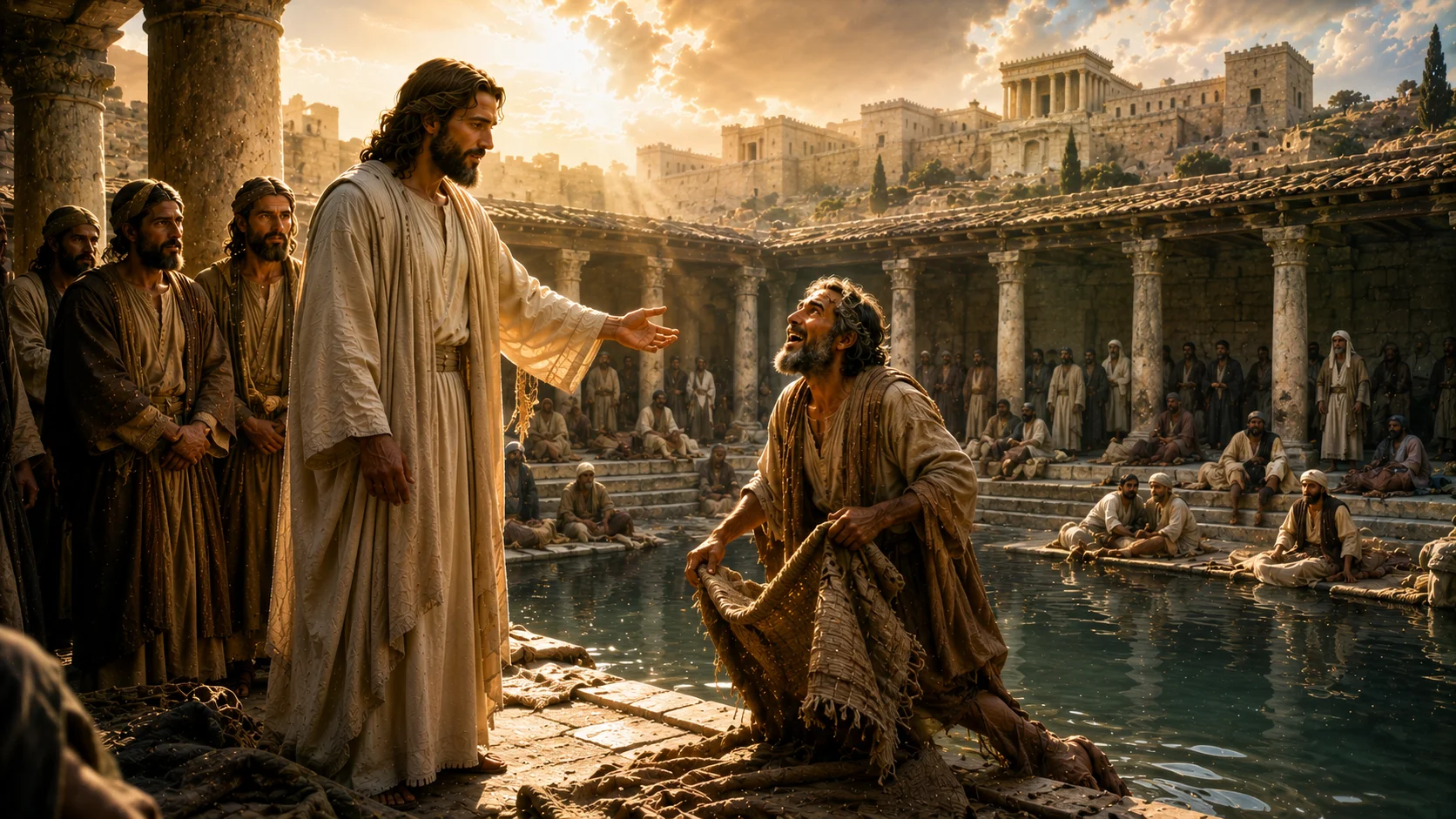
John Chapter 5 reveals the growing conflict surrounding Jesus Christ as He demonstrates His authority through the healing of a man who had been unable to walk for thirty-eight years and then explains His unique relationship with God the Father.
After healing the man at the Pool of Bethesda on the Sabbath, Jesus faces opposition from Jewish religious leaders. Rather than retreating from the controversy, Jesus makes extraordinary claims about His authority to give life, execute judgment, and raise the dead. The chapter concludes with Jesus presenting multiple witnesses confirming His identity, including John the Baptist, His miraculous works, the Father, the Scriptures, and Moses.
John Chapter 5 Summary
John 5 begins with Jesus traveling to Jerusalem during a Jewish feast.
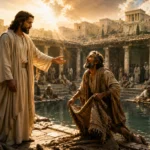
Near the Sheep Gate is a pool called Bethesda, surrounded by five covered porches. Many sick and disabled people gather there.
Among them is a man who has suffered from his condition for thirty-eight years.
Jesus sees the man lying there and, knowing how long he has suffered, asks him:
“Wilt thou be made whole?”
The man explains that he has no one to help him into the pool when the water is stirred and that someone else always reaches it before him.
Jesus does not place the man’s hope in the pool.
Instead, He commands:
“Rise, take up thy bed, and walk.”
Immediately, the man is healed. He picks up his mat and begins walking.
However, the miracle occurs on the Sabbath.
Rather than focusing on the extraordinary restoration of a man who had suffered for decades, religious leaders object because he is carrying his mat on the Sabbath.
When questioned, the healed man explains that the person who healed him instructed him to carry it, although at first he does not know Jesus’ identity.
Later, Jesus finds him in the Temple and warns him to turn away from sin.
After learning that Jesus healed him, the man tells the religious authorities.
Their opposition toward Jesus intensifies because He performed the healing on the Sabbath.
Jesus responds:
“My Father worketh hitherto, and I work.”
This statement creates an even greater controversy. His opponents understand Jesus as making Himself equal with God by speaking of God uniquely as His Father.
Jesus then explains His relationship with the Father.
The Son does what He sees the Father doing. The Father loves the Son and reveals His works to Him.
Jesus declares that just as the Father raises the dead and gives life, the Son also gives life to whom He wills.
He then makes another remarkable claim: the Father has entrusted judgment to the Son so that everyone should honor the Son just as they honor the Father.
Jesus declares that whoever hears His word and believes the One who sent Him possesses eternal life and has passed from death into life.
He then speaks about resurrection.
A time is coming when the dead will hear His voice and rise. Those who have done good will rise to the resurrection of life, while those characterized by evil will face judgment.
Jesus next discusses the witnesses confirming His identity.
John the Baptist testified concerning Him.
Jesus’ miraculous works provide an even greater testimony because they demonstrate that the Father sent Him.
The Father Himself bears witness concerning Jesus.
The Scriptures also testify about Him.
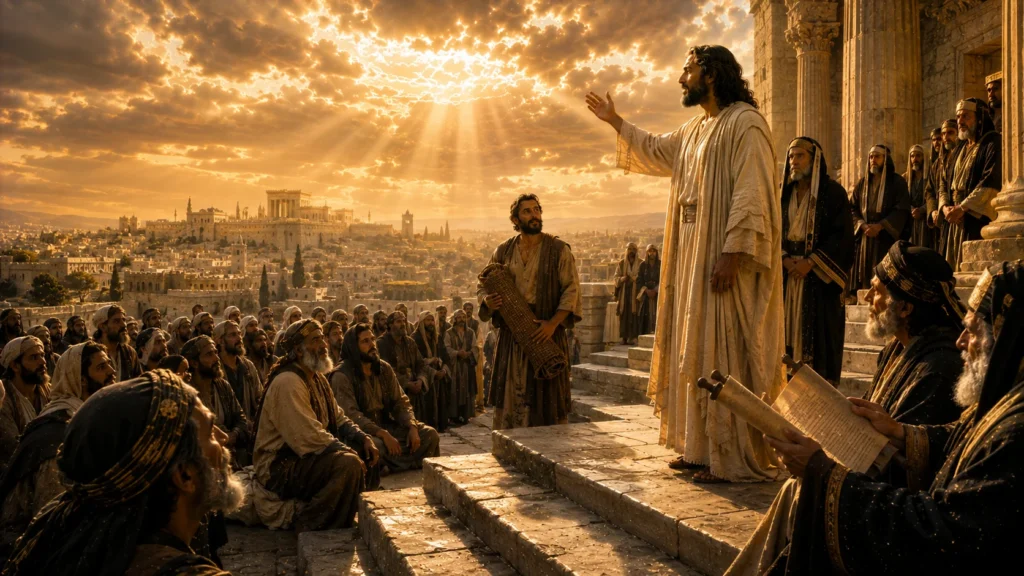
Jesus confronts the religious leaders because they diligently study Scripture while refusing to come to the very One to whom Scripture points.
He tells them:
“Search the scriptures; for in them ye think ye have eternal life: and they are they which testify of me.”
Finally, Jesus points to Moses.
The religious leaders claimed to trust Moses, yet Jesus explains that Moses wrote about Him. If they truly believed Moses, they would recognize the One to whom Moses’ writings ultimately pointed.
John Chapter 5 therefore moves from a physical healing at Bethesda to profound teaching concerning Jesus’ identity.
Jesus is presented not merely as a miracle worker, but as the Son who gives life, possesses authority to judge, raises the dead, grants eternal life, and deserves the same honor given to the Father.
Key Lessons – John Chapter 5
- Jesus sees people whom others may overlook.
- The man at Bethesda had suffered for thirty-eight years, but Jesus knew his condition and approached him personally.
- Christ’s power is not dependent upon human resources.
- The man believed he needed someone to place him into the pool, but Jesus healed him directly by His word.
- Jesus possesses authority to restore what appears hopeless.
- Thirty-eight years of suffering could not prevent immediate healing when Christ commanded the man to rise.
- Religious rules should never blind people to God’s work.
- The leaders became focused on Sabbath controversy while overlooking an extraordinary act of restoration.
- Jesus possesses a unique relationship with God the Father.
- His teaching goes far beyond that of an ordinary prophet or teacher.
- Jesus has authority to give life.
- The chapter presents Christ as the One through whom spiritual and resurrection life are given.
- Jesus has authority to execute judgment.
- The Father has entrusted judgment to the Son, demonstrating Christ’s extraordinary divine authority.
- Eternal life begins through faith in Christ.
- Jesus describes believers as having already passed from death into life.
- Scripture ultimately points people toward Christ.
- Bible knowledge alone is insufficient if someone refuses to recognize the One to whom Scripture testifies.
- Evidence for Jesus comes from multiple witnesses.
- John the Baptist, Christ’s works, the Father, Scripture, and Moses all testify concerning Him.
Important Verses
- John 5:6 — Jesus sees the suffering man at Bethesda and asks him, “Wilt thou be made whole?”
- John 5:8–9 — Jesus commands the man to rise, take up his bed, and walk, and the man is immediately healed.
- John 5:17 — “My Father worketh hitherto, and I work.”
- John 5:19 — Jesus explains that the Son acts in perfect unity with what He sees the Father doing.
- John 5:21 — Just as the Father raises the dead and gives life, the Son also gives life.
- John 5:22–23 — The Father entrusts judgment to the Son so that all should honor the Son just as they honor the Father.
- John 5:24 — Whoever hears Christ’s word and believes the One who sent Him has everlasting life and has passed from death into life.
- John 5:25 — Jesus declares that the dead will hear the voice of the Son of God, and those who hear will live.
- John 5:28–29 — Jesus foretells a future resurrection when those in the graves will hear His voice and come forth.
- John 5:36 — Jesus points to His works as testimony that the Father has sent Him.
- John 5:39 — “Search the scriptures; for in them ye think ye have eternal life: and they are they which testify of me.”
- John 5:46 — Jesus declares that Moses wrote concerning Him.