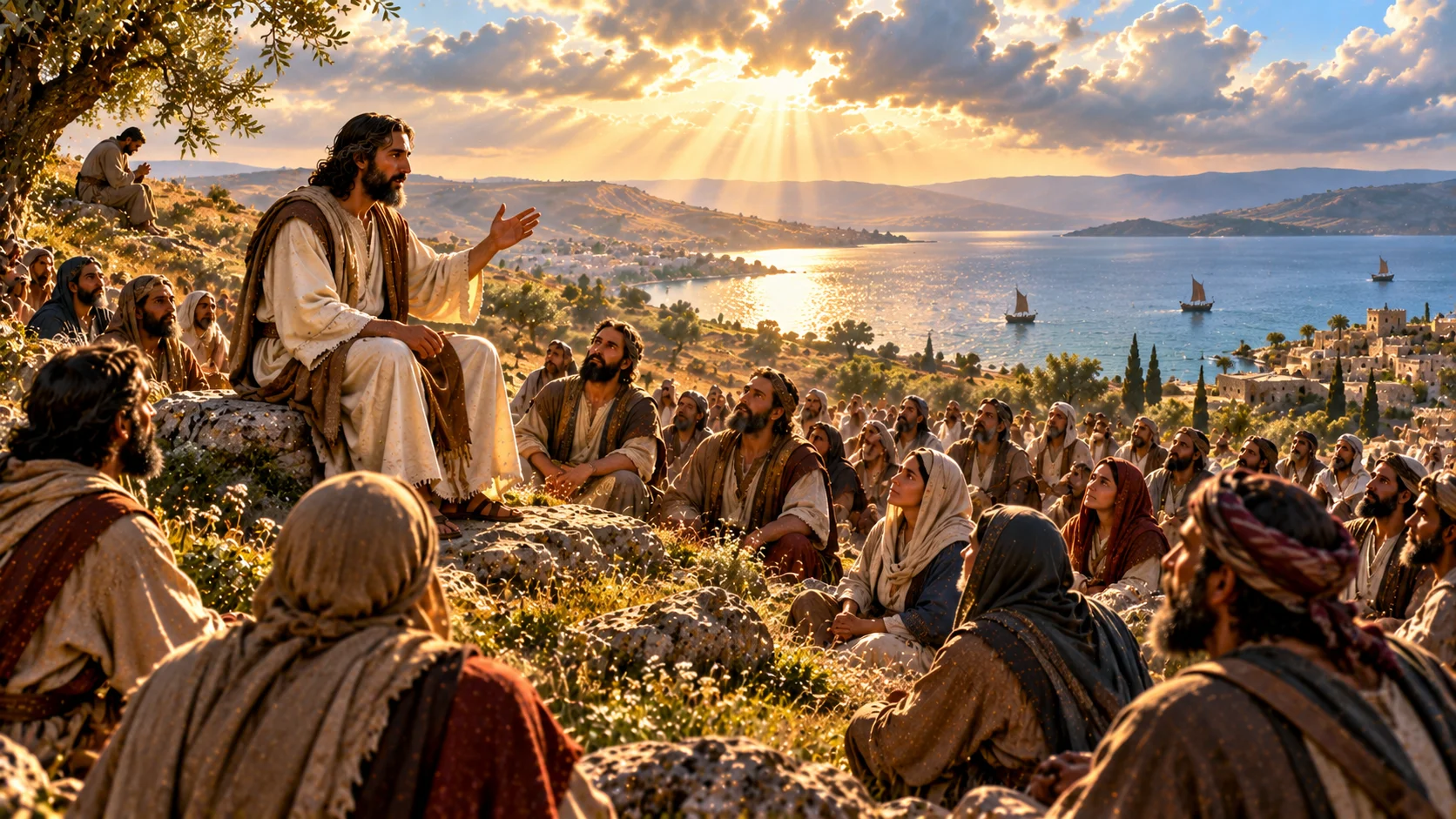
Matthew Chapter 6 continues Jesus’ Sermon on the Mount and focuses on what genuine devotion to God looks like. Jesus warns against practicing righteousness merely to receive praise from other people. He teaches about giving to the needy, prayer, fasting, forgiveness, heavenly treasure, loyalty to God, and freedom from anxiety. This chapter also contains the Lord’s Prayer, one of Jesus’ most important teachings on prayer. Throughout Matthew 6, Jesus repeatedly directs attention away from outward appearances and toward the heart. The central message is clear: seek God’s kingdom first, trust your heavenly Father, and live for eternal treasure rather than temporary earthly approval or possessions.
Matthew Chapter 6 Summary
Matthew Chapter 6 begins with Jesus warning His listeners about the motives behind acts of righteousness.
He teaches that good deeds should not be performed simply:
“To be seen of men.”
Jesus first applies this principle to giving.
When helping the poor, His followers should not announce their generosity so that others will praise them.
Jesus describes hypocrites who make their charitable actions highly visible because they desire recognition.
Their reward is the praise they receive from people.
Instead, Jesus teaches His followers to give quietly and sincerely.
He says:
“Let not thy left hand know what thy right hand doeth.”
The point is not that generosity must always be completely secret.
Rather, giving should be motivated by love for God and others instead of a desire for admiration.
The Father sees what is done in secret.
Jesus then turns to prayer.
Again, He warns against hypocrisy.
Some people deliberately pray where others will notice them because they enjoy appearing spiritual.
Jesus instructs His followers to seek God sincerely rather than turning prayer into a performance.
He says:
“Enter into thy closet, and when thou hast shut thy door, pray to thy Father which is in secret.”
Jesus also warns against meaningless repetition.
Prayer does not become more effective simply because many words are spoken.
God already knows what His people need before they ask Him.
Jesus then provides a model for prayer that has become known as the Lord’s Prayer:
“Our Father which art in heaven, Hallowed be thy name.”
The prayer begins with God rather than ourselves.
His name is honored.
His kingdom is desired.
His will is sought.
Jesus teaches His disciples to pray:
“Thy kingdom come. Thy will be done in earth, as it is in heaven.”
The prayer then turns toward daily dependence upon God:
“Give us this day our daily bread.”
Jesus teaches His followers to trust God for their needs.
Next comes forgiveness:
“And forgive us our debts, as we forgive our debtors.”
Those who receive God’s mercy should themselves become merciful and forgiving.
The prayer concludes with dependence upon God for spiritual protection:
“And lead us not into temptation, but deliver us from evil.”
Jesus then emphasizes the importance of forgiveness.
He teaches that those who have received mercy from God must be willing to extend forgiveness toward others.
The chapter next addresses fasting.
Jesus again confronts religious performance.
Some people deliberately make themselves look miserable while fasting so others will recognize their supposed spirituality.
Jesus tells His followers not to advertise their fasting.
Their devotion should be directed toward God rather than toward gaining human admiration.
The repeated pattern becomes unmistakable:
giving → prayer → fasting.
All three are good spiritual practices.
But all three can become corrupted when they are performed primarily to impress other people.
Jesus then shifts from religious practices to possessions and priorities.
He commands:
“Lay not up for yourselves treasures upon earth.”
Earthly possessions are temporary.
Moths destroy.
Corrosion consumes.
Thieves steal.
Instead, Jesus says:
“Lay up for yourselves treasures in heaven.”
He then gives one of the chapter’s most important principles:
“For where your treasure is, there will your heart be also.”
What a person values reveals the direction of that person’s heart.
Jesus follows this with an illustration about the eye being the lamp of the body.
A healthy spiritual perspective fills life with light, while a corrupted perspective produces darkness.
He then makes the issue of loyalty unmistakable:
“No man can serve two masters.”
Eventually one master will take priority over the other.
Jesus concludes:
“Ye cannot serve God and mammon.”
Money itself is not presented as inherently evil.
The warning concerns allowing wealth to become a rival master competing with God for our trust, devotion, and obedience.
Jesus then addresses worry and anxiety about material needs.
He tells His followers:
“Take no thought for your life, what ye shall eat, or what ye shall drink.”
In this context, Jesus is warning against consuming anxiety rather than responsible planning.
He points His listeners toward the natural world.
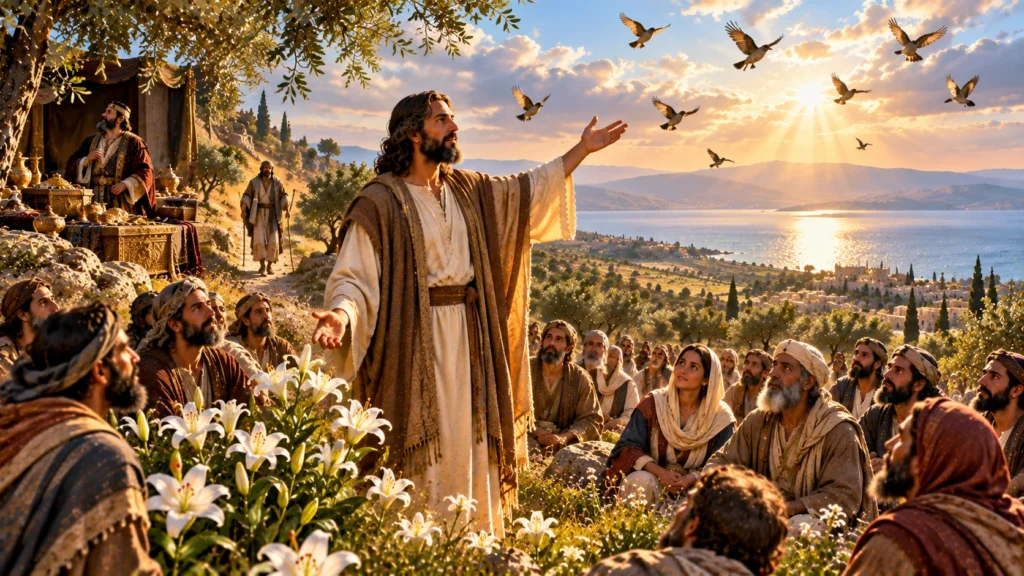
First, Jesus directs their attention to the birds of the air.
They do not sow fields, harvest crops, or store food in barns in the human sense.
Yet the heavenly Father feeds them.
Jesus asks:
“Are ye not much better than they?”
He then points toward the lilies of the field.
They do not labor to manufacture clothing.
Yet their beauty exceeds even the magnificence of Solomon.
If God clothes temporary grass and flowers with such beauty, Jesus asks how much more He will care for His people.
Worry cannot control the future.
Jesus asks:
“Which of you by taking thought can add one cubit unto his stature?”
Anxiety cannot provide the security people seek.
Jesus tells His followers that their heavenly Father already knows what they need.
Instead of allowing food, clothing, possessions, and tomorrow’s uncertainties to dominate their lives, Jesus gives them a greater priority:
“But seek ye first the kingdom of God, and his righteousness.”
Everything else must become secondary to pursuing God and His righteous rule.
Jesus then concludes:
“Take therefore no thought for the morrow.”
Each day has enough difficulty of its own.
His followers are called to trust God today rather than allowing imagined troubles of tomorrow to consume them.
Matthew Chapter 6 therefore presents a powerful progression:
sincere giving → genuine prayer → forgiveness → sincere fasting → heavenly treasure → undivided loyalty → trust in the Father → seeking God’s kingdom first.
The chapter repeatedly brings the believer back to one central question:
Who truly has your heart?
Key Lessons – Matthew Chapter 6
- God cares about our motives, not merely our outward actions. Giving, prayer, and fasting can all appear righteous while being motivated by pride.
- Our relationship with God should not become a performance for other people. Jesus repeatedly emphasizes that the Father sees what is done in secret.
- Prayer begins with God’s glory and His kingdom. The Lord’s Prayer teaches us to seek God’s name, kingdom, and will before focusing upon our own needs.
- We should depend upon God daily. Asking for daily bread reminds us that everything we need ultimately comes from our heavenly Father.
- Those who receive forgiveness should practice forgiveness. God’s mercy should transform the way we respond to people who wrong us.
- Earthly possessions are temporary. Jesus encourages His followers to invest their lives in treasures that cannot decay, disappear, or be stolen.
- We cannot serve both God and money as masters. Wealth must remain a servant rather than becoming the object of our trust and devotion.
- Worry cannot control tomorrow. Jesus redirects anxious hearts toward the faithful care of the heavenly Father.
- God knows what His people need. The birds and lilies illustrate His attentive provision and care.
- Our highest priority should be God’s kingdom and righteousness. Everything else must be ordered around the command to “seek ye first the kingdom of God.”
Important Verses
- Matthew 6:6
- “But thou, when thou prayest, enter into thy closet… and thy Father, which seeth in secret, shall reward thee openly.”
- Matthew 6:9
- “Our Father which art in heaven, Hallowed be thy name.”
- Matthew 6:10
- “Thy kingdom come. Thy will be done in earth, as it is in heaven.”
- Matthew 6:11
- “Give us this day our daily bread.”
- Matthew 6:12
- “And forgive us our debts, as we forgive our debtors.”
- Matthew 6:19–20
- “Lay not up for yourselves treasures upon earth… But lay up for yourselves treasures in heaven.”
- Matthew 6:21
- “For where your treasure is, there will your heart be also.”
- Matthew 6:24
- “No man can serve two masters… Ye cannot serve God and mammon.”
- Matthew 6:26
- “Behold the fowls of the air… your heavenly Father feedeth them. Are ye not much better than they?”
- Matthew 6:33
- “But seek ye first the kingdom of God, and his righteousness; and all these things shall be added unto you.”
- Matthew 6:34
- “Take therefore no thought for the morrow.”