Luke Chapter 6 reveals Jesus’ authority, compassion, and radical teaching about life in the kingdom of God. Jesus confronts religious leaders over the true purpose of the Sabbath, heals a man with a withered hand, chooses the twelve apostles after spending the night in prayer, and ministers to a great multitude. He then delivers powerful teachings about blessings and woes, loving enemies, showing mercy, refusing hypocritical judgment, recognizing people by their fruit, and building life upon obedience to His words. Throughout the chapter, Jesus teaches that genuine discipleship goes far beyond outward religion—it produces mercy, generosity, forgiveness, humility, love for enemies, and faithful obedience.
Luke Chapter 6 Summary
Luke Chapter 6 begins with Jesus and His disciples walking through grainfields on the Sabbath.
The disciples pluck heads of grain, rub them in their hands, and eat.
Some Pharisees challenge them:
“Why do ye that which is not lawful to do on the sabbath days?”
Jesus responds by reminding them about David.
When David and his companions were hungry, he entered the house of God and ate the consecrated bread normally reserved for the priests.
Jesus then makes an extraordinary declaration:
“The Son of man is Lord also of the sabbath.”
Jesus is asserting His authority over the Sabbath itself.
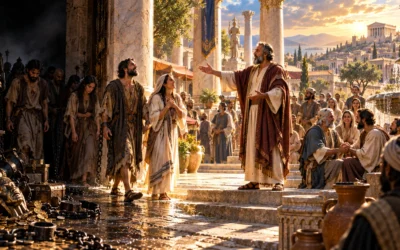
On another Sabbath, Jesus enters a synagogue and teaches.
A man is present whose right hand is withered.
The scribes and Pharisees carefully watch Jesus.
They are not primarily concerned about the suffering man.
They want to discover whether Jesus will heal on the Sabbath so they can accuse Him.
Jesus knows their thoughts.
He tells the man:
“Rise up, and stand forth in the midst.”
Jesus then asks His opponents whether it is lawful on the Sabbath to do good or evil, to save life or destroy it.
After looking around at them, Jesus commands:
“Stretch forth thy hand.”
The man obeys.
His hand is completely restored.
Instead of celebrating the healing, the religious leaders become filled with rage and begin discussing what they might do to Jesus.
Luke then describes an important moment before Jesus chooses His apostles.
Jesus goes onto a mountain to pray.
He spends:
“All night in prayer to God.”
When morning comes, Jesus calls His disciples and chooses twelve, whom He also names apostles:
Simon Peter, Andrew, James, John, Philip, Bartholomew, Matthew, Thomas, James son of Alphaeus, Simon called Zelotes, Judas brother of James, and Judas Iscariot.
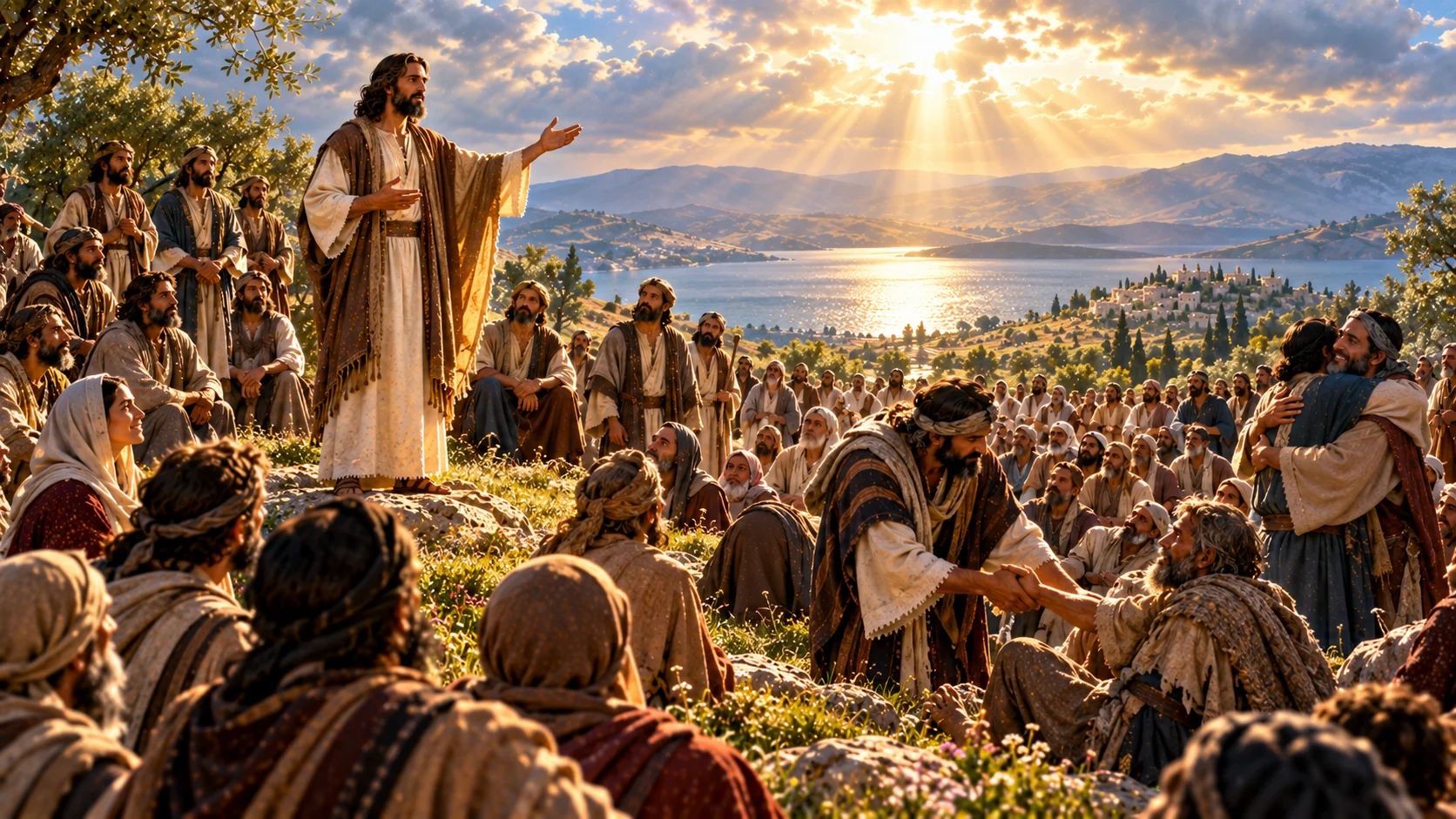
Jesus then descends with them and stands upon a level place.
A great multitude gathers from Judea, Jerusalem, Tyre, Sidon, and surrounding regions.
They have come to hear Jesus and to be healed.
Those troubled by unclean spirits are delivered.
Luke describes extraordinary healing power:
“There went virtue out of him, and healed them all.”
Jesus then turns toward His disciples and begins teaching.
He announces blessings upon people the world might consider unfortunate.
“Blessed be ye poor: for yours is the kingdom of God.”
He blesses those who hunger.
They will be filled.
He blesses those who weep.
They will laugh.
He even declares that His followers can rejoice when they are hated, rejected, insulted, and persecuted because of the Son of Man.
Their reward in heaven is great.
But Jesus also pronounces woes.
“Woe unto you that are rich! for ye have received your consolation.”
He warns those who are presently full, those who laugh without concern for God, and those who receive universal human praise.
Jesus is exposing the danger of finding complete satisfaction in temporary prosperity while neglecting eternal realities.
Then comes one of the chapter’s most challenging commands:
“Love your enemies.”
Jesus continues:
“Do good to them which hate you.”
“Bless them that curse you.”
“Pray for them which despitefully use you.”
Jesus calls His followers to respond to hostility in a radically different way.
Instead of revenge, they are to demonstrate love.
Instead of returning hatred, they are to do good.
Instead of answering curses with curses, they are to bless.
Jesus teaches generosity without constantly calculating what will be received in return.
He gives the principle often called the Golden Rule:
“As ye would that men should do to you, do ye also to them likewise.”
Jesus explains that loving only people who already love us is not extraordinary.
Even sinners do that.
Likewise, doing good only to those who will return the favor does not distinguish His followers.
Instead:
“Love ye your enemies, and do good, and lend, hoping for nothing again.”
Jesus connects this behavior with the character of God.
God is kind even:
“Unto the unthankful and to the evil.”
Therefore Jesus commands:
“Be ye therefore merciful, as your Father also is merciful.”
Mercy becomes one of the defining characteristics of genuine discipleship.
Jesus then warns against judgmental hypocrisy.
“Judge not, and ye shall not be judged.”
“Condemn not, and ye shall not be condemned.”
“Forgive, and ye shall be forgiven.”
Jesus also teaches generosity:
“Give, and it shall be given unto you.”
He describes a generous measure—pressed down, shaken together, and overflowing.
The standard people use toward others will return upon them.
Jesus then gives the image of the blind leading the blind.
If one spiritually blind person attempts to guide another, both can fall into a ditch.
A disciple must first learn from the master.
Jesus follows with one of His most memorable illustrations about hypocrisy.
Why notice a tiny speck in another person’s eye while ignoring the large beam in your own?
Jesus says:
“Thou hypocrite, cast out first the beam out of thine own eye.”
Only then can someone see clearly enough to help another.
Jesus is not teaching indifference toward right and wrong.
He is condemning self-righteous, hypocritical judgment that exposes another person’s failures while refusing to confront one’s own.
Jesus then uses trees and fruit to explain the relationship between the heart and behavior.
A good tree does not produce corrupt fruit.
A corrupt tree does not produce good fruit.
“For every tree is known by his own fruit.”
The same principle applies to people.
Jesus explains:
“A good man out of the good treasure of his heart bringeth forth that which is good.”
But an evil heart produces evil.
Then comes the principle:
“For of the abundance of the heart his mouth speaketh.”
Words and actions reveal what is being cultivated within the heart.
Jesus concludes the chapter by asking a penetrating question:
“And why call ye me, Lord, Lord, and do not the things which I say?”
Calling Jesus “Lord” while refusing His teaching is inconsistent.
Jesus illustrates this with two builders.
The first person comes to Jesus, hears His words, and does them.
Jesus compares that person to someone who digs deeply and builds a house upon solid rock.
When the flood comes and the river violently strikes the house, it cannot shake it.
Its foundation is secure.
The second person hears Jesus’ teaching but does not obey.
That person is like someone who builds a house without a foundation.
When the flood strikes, the house immediately collapses.
Jesus concludes:
“And the ruin of that house was great.”
Luke Chapter 6 therefore presents a powerful progression:
Jesus Lord of the Sabbath → healing and compassion → prayer → twelve apostles chosen → blessings and woes → love your enemies → mercy and forgiveness → examine yourself → good fruit from a good heart → hear Jesus and obey.
The chapter ultimately teaches that genuine discipleship is not merely hearing Jesus.
It is becoming the kind of person who lives according to His words.

Key Lessons – Luke Chapter 6
- Jesus is Lord of the Sabbath. Religious traditions must never become more important than the One to whom the Sabbath belongs.
- Compassion should never be sacrificed for religious appearance. Jesus heals the man with the withered hand while His opponents care more about accusing Him than helping the suffering man.
- Important decisions should be surrounded by prayer. Jesus spends the entire night praying before choosing the twelve apostles.
- God’s kingdom reverses many worldly values. Poverty, hunger, sorrow, rejection, wealth, comfort, and popularity must all be evaluated from an eternal perspective.
- Followers of Jesus are called to love their enemies. Christian love extends beyond people who treat us well.
- Mercy reflects the character of God. Jesus commands His followers to be merciful because their heavenly Father is merciful.
- Forgiveness and generosity should characterize discipleship. Jesus teaches His followers to forgive rather than condemn and to give generously.
- We should examine ourselves before criticizing others. The beam and speck illustration warns against hypocritical judgment.
- Our lives reveal what is inside our hearts. Just as a tree is recognized by its fruit, words and actions reveal a person’s inner character.
- Hearing Jesus without obeying Him leaves life without a secure foundation. Genuine discipleship means hearing Christ’s teaching and putting it into practice.
Important Verses
- Luke 6:5
- “And he said unto them, That the Son of man is Lord also of the sabbath.”
- Luke 6:12
- “He went out into a mountain to pray, and continued all night in prayer to God.”
- Luke 6:20
- “Blessed be ye poor: for yours is the kingdom of God.”
- Luke 6:27
- “But I say unto you which hear, Love your enemies, do good to them which hate you.”
- Luke 6:31
- “And as ye would that men should do to you, do ye also to them likewise.”
- Luke 6:35
- “But love ye your enemies, and do good, and lend, hoping for nothing again.”
- Luke 6:36
- “Be ye therefore merciful, as your Father also is merciful.”
- Luke 6:37
- “Judge not, and ye shall not be judged: condemn not, and ye shall not be condemned: forgive, and ye shall be forgiven.”
- Luke 6:38
- “Give, and it shall be given unto you.”
- Luke 6:44
- “For every tree is known by his own fruit.”
- Luke 6:45
- “For of the abundance of the heart his mouth speaketh.”
- Luke 6:46
- “And why call ye me, Lord, Lord, and do not the things which I say?”
- Luke 6:48
- “He is like a man which built an house, and digged deep, and laid the foundation on a rock.”