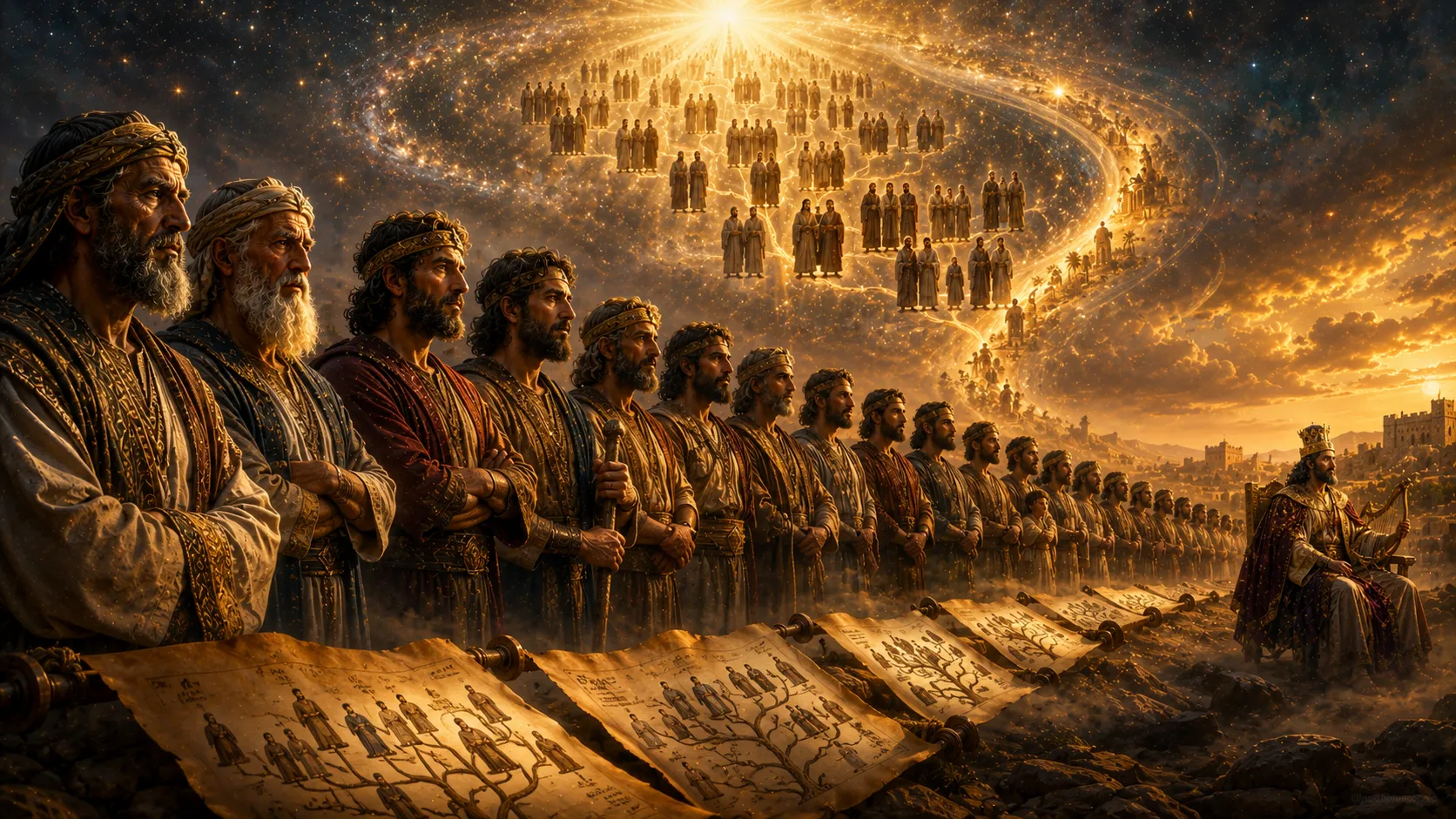
1 Chronicles Chapter 2 continues the genealogical record of Israel by focusing on the descendants of Judah, the royal tribe from which King David and ultimately Jesus Christ would come. This chapter highlights God’s covenant purposes through family lines and demonstrates how He preserved the lineage that would play a central role in Israel’s history and His plan of redemption.
1 Chronicles Chapter 2 Summary
The chapter begins by listing the sons of Israel (Jacob), reminding readers of the twelve tribes that formed the nation of Israel.
The primary focus then shifts to the tribe of Judah, one of the most important tribes in biblical history. Judah’s descendants are carefully traced because God chose this tribe as the royal line through which kings would come.
The genealogy starts with Judah’s sons: Er, Onan, and Shelah. Er’s wickedness led to his death before the Lord, and the family line continued through Perez, Judah’s son by Tamar.
The descendants of Perez are listed in detail, including Hezron, one of the key ancestors in Judah’s lineage. The genealogy continues through several generations, showing the growth and influence of Judah’s family.
Special attention is given to notable descendants such as Ram, Amminadab, Nahshon, and Salmon. Nahshon was a leader of Judah during Israel’s wilderness journey under Moses.
The chapter also records the descendants of Hezron, including Caleb and Jerahmeel. Caleb is remembered as one of the faithful spies who trusted God’s promise concerning the Promised Land.
Various clans, cities, and family groups are mentioned, demonstrating the expansion of Judah’s descendants throughout the land.
The genealogy gradually moves closer to the royal family that would eventually produce King David. These records preserved the historical and covenantal significance of Judah’s line.
While much of the chapter consists of names and family records, it serves an important purpose by showing God’s faithfulness across generations. Every family listed contributed to the unfolding story of Israel and God’s redemptive plan.
1 Chronicles Chapter 2 reminds readers that God works through generations, families, and ordinary people to accomplish His purposes in history.
Key Lessons From 1 Chronicles 2
- God faithfully works through generations to accomplish His plans.
- Every person has a place within God’s greater story.
- God’s promises endure across centuries.
- Faithfulness leaves a lasting legacy for future generations.
- God preserves His covenant purposes despite human failures.
- Family heritage can play an important role in spiritual history.
- God’s redemptive plan unfolds according to His perfect design.
Important Verses
- 1 Chronicles 2:1-2 — The sons of Israel are listed.
- 1 Chronicles 2:4 — Perez becomes a key ancestor in Judah’s line.
- 1 Chronicles 2:10 — Nahshon is identified among Judah’s descendants.
- • Chronicles 2:18-20 — Caleb’s family line is recorded.
- 1 Chronicles 2:50-55 — Additional descendants and clans of Judah are listed.