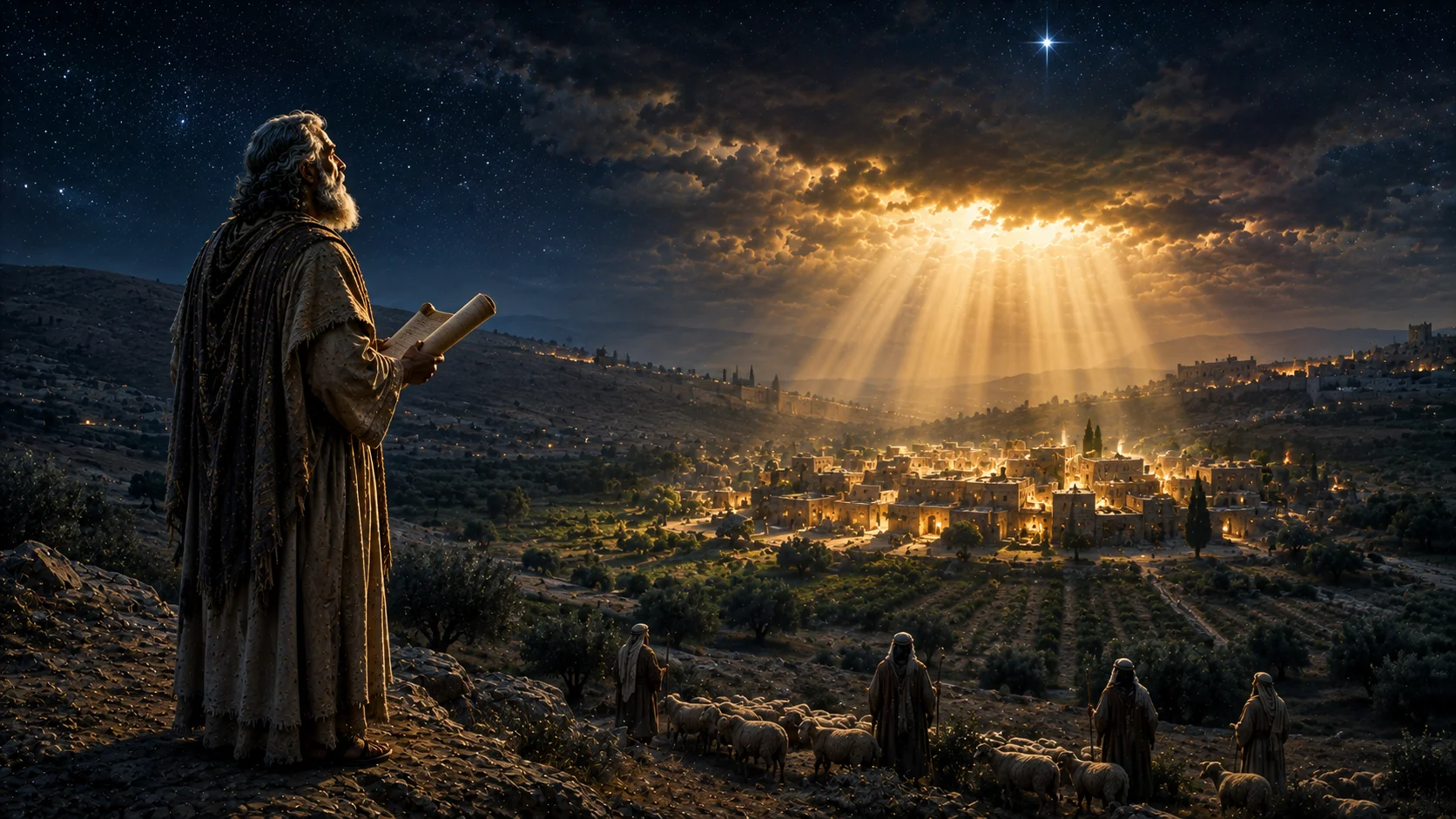
Micah Chapter 5 contains one of the Old Testament’s most significant prophecies concerning the coming Messiah. Although Jerusalem faces humiliation and enemy attack, Micah looks beyond the immediate crisis toward a future ruler who will come from the small town of Bethlehem.
This promised ruler will shepherd God’s people in the strength of the Lord, and His greatness will extend to the ends of the earth. The chapter also describes God preserving a remnant, delivering His people from their enemies, and removing the military power, idolatry, and false spiritual practices upon which they had depended. Micah 5 combines judgment with extraordinary hope, pointing toward the Messiah and God’s ultimate restoration of His people.
Micah Chapter 5 Summary
Micah 5 begins with Jerusalem facing a humiliating siege. Israel’s ruler will be struck, presenting a bleak picture of national weakness and approaching judgment.
Against this dark background comes one of Scripture’s most famous messianic prophecies.
Micah announces that Bethlehem Ephratah, though small among the clans of Judah, will become the birthplace of a ruler over Israel whose origins are described as being “from of old, from everlasting.”
Bethlehem appeared insignificant compared with the great cities of the ancient world, yet God chose it for an extraordinary purpose.
This prophecy would later be specifically connected with the birth of Jesus Christ in Matthew 2:5–6.
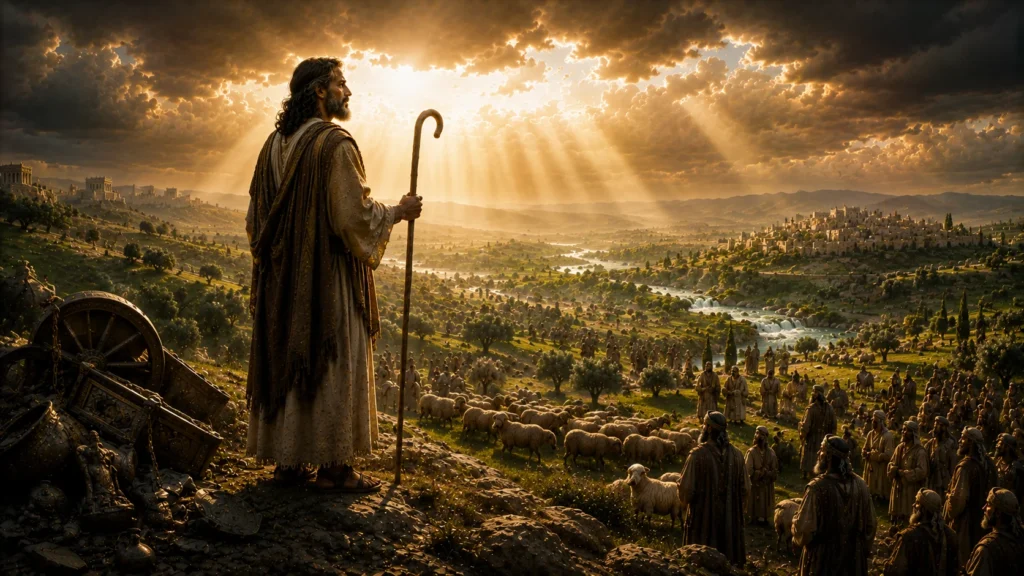
Micah then describes this ruler as a shepherd.
He will stand and shepherd His people in the strength of the Lord and in the majesty of God’s name. His people will dwell securely because His greatness will reach to the ends of the earth.
Micah declares that “this man shall be the peace.”
The prophecy then returns to the threat of Assyria. When the enemy invades, God will provide leadership and deliverance for His people.
Micah describes the remnant of Jacob living among many nations using two contrasting images.
First, they will be like dew from the Lord and showers upon grass—quietly bringing refreshing blessing that does not depend upon human power.
Then they are compared to a lion among the animals of the forest, representing strength and victory over opposition.
The final portion of the chapter describes a future purification.
God will remove horses, chariots, fortified cities, witchcraft, soothsayers, carved images, sacred pillars, and other sources of false security and idolatry.
The purpose is clear: God’s people must no longer place their confidence in military strength, human defenses, idols, or occult practices.
Micah Chapter 5 therefore moves from humiliation to hope, from enemy invasion to divine deliverance, and from spiritual corruption to purification.
At the center of that hope stands the promised ruler from Bethlehem—the shepherd-king whose greatness will extend throughout the earth.
Key Lessons – Micah Chapter 5
- God can bring His greatest purposes from seemingly insignificant places.
- Bethlehem was small, yet God chose it as the birthplace of the promised ruler.
- God’s promises remain trustworthy during dark circumstances.
- The prophecy of the Messiah appears in the middle of warnings about siege, humiliation, and judgment.
- Jesus fulfills Micah’s prophecy concerning Bethlehem.
- The New Testament directly connects Micah’s prophecy with the birthplace of Jesus Christ.
- The Messiah is portrayed as a shepherd.
- His leadership is characterized by strength, protection, provision, and care for God’s people.
- True peace ultimately comes through God’s promised ruler.
- Micah does not merely say the ruler will bring peace; he declares that He Himself will be peace.
- God preserves a faithful remnant.
- Even amid judgment and dispersion, God’s covenant purposes continue through the people He preserves.
- Human power should never replace dependence upon God.
- Military resources, fortified cities, and other forms of earthly security cannot substitute for trusting the Lord.
- God desires to remove idolatry from His people.
- The chapter anticipates a purification in which idols and false spiritual practices are destroyed.
- The Messiah’s greatness extends beyond Bethlehem and Israel.
- The ruler emerging from a small Judean town will ultimately be great “unto the ends of the earth.”
Important Verses
- Micah 5:2 — “But thou, Bethlehem Ephratah, though thou be little among the thousands of Judah, yet out of thee shall he come forth unto me that is to be ruler in Israel.”
- Micah 5:4 — The promised ruler will stand and shepherd His people in the strength of the Lord, and His greatness will extend to the ends of the earth.
- Micah 5:5 — “And this man shall be the peace.”
- Micah 5:7 — The remnant of Jacob among many peoples is compared to dew from the Lord and showers upon the grass.
- Micah 5:8 — The remnant is also compared to a lion among the animals, emphasizing strength and victory.
- Micah 5:10–11 — God declares that He will remove horses, chariots, and fortified cities from His people.
- Micah 5:12 — God promises to eliminate witchcraft and soothsayers.
- Micah 5:13 — Carved images and sacred pillars will be destroyed so that the people no longer worship what their own hands have made.