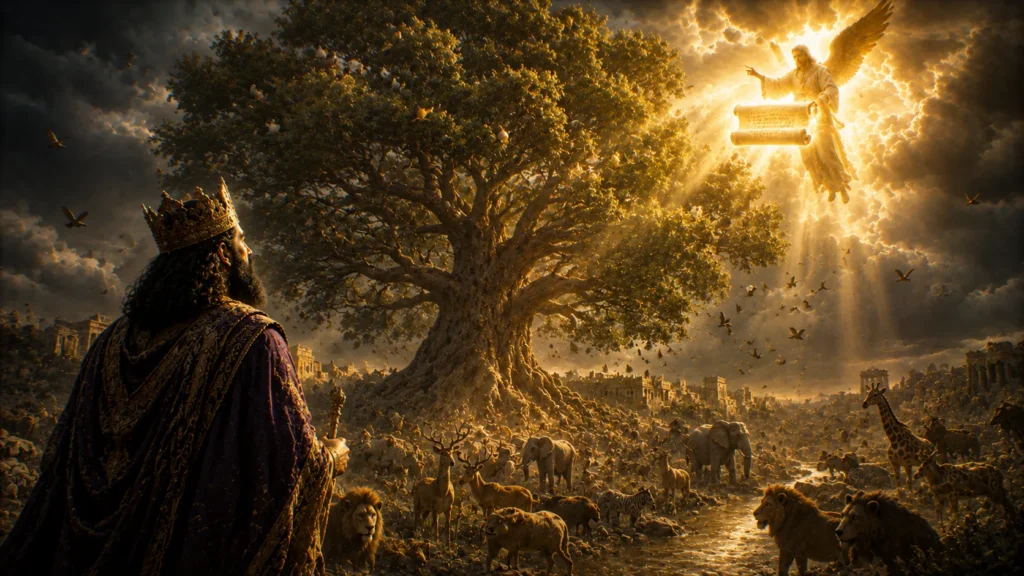

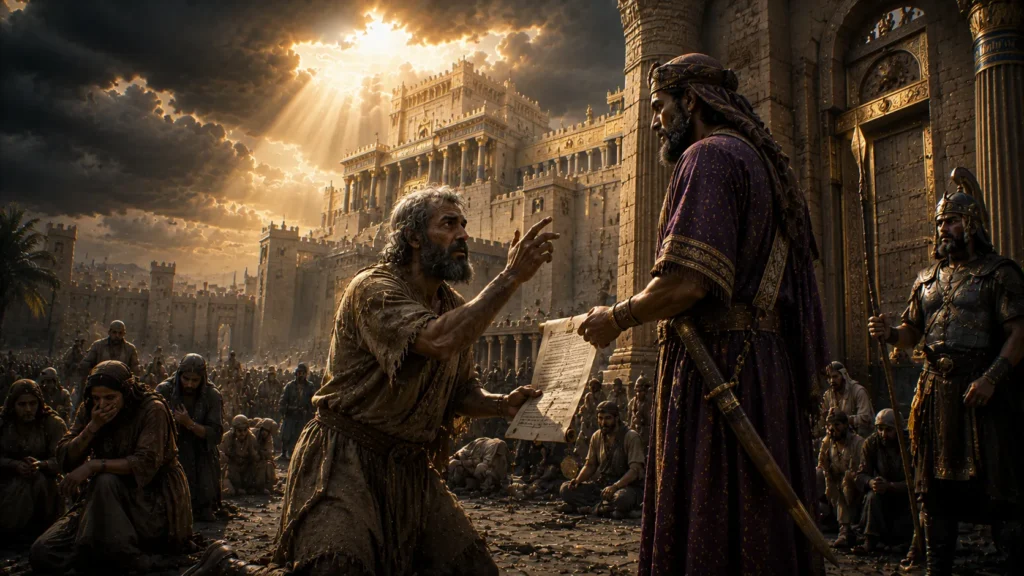

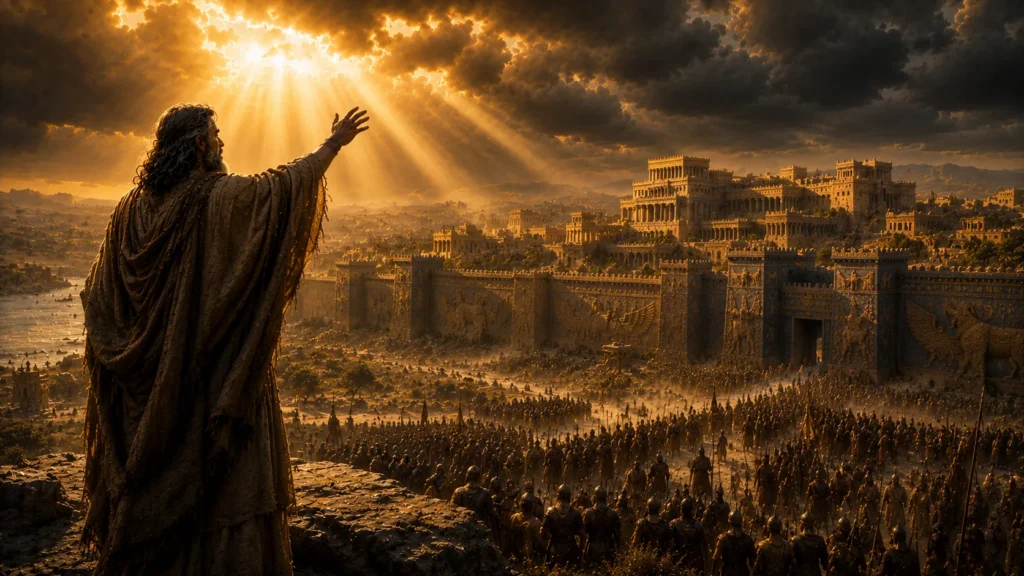
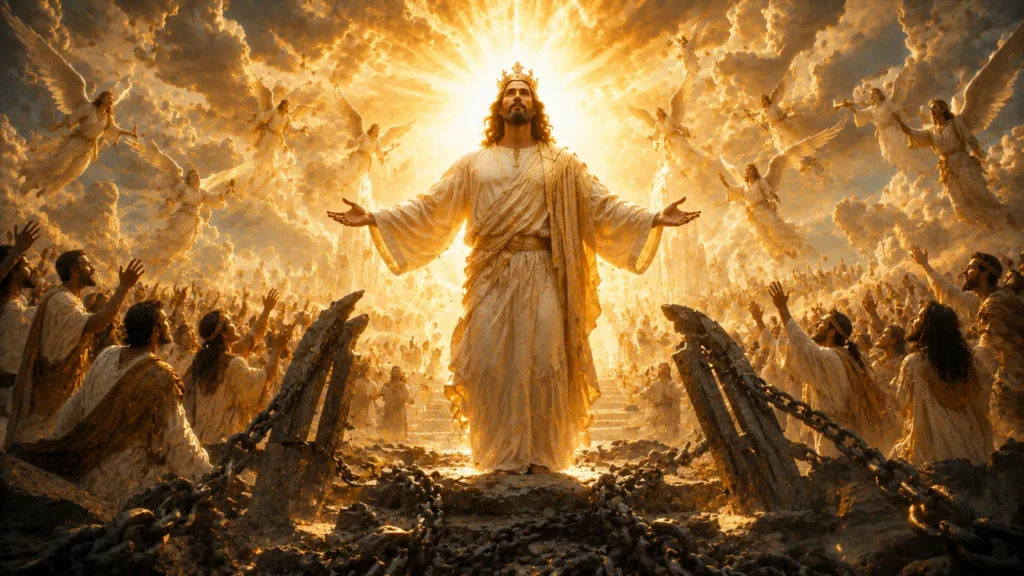



Zechariah Chapter 5 records two striking visions given to the prophet Zechariah: the flying scroll and the woman in the basket. Together, these visions reveal that God’s restoration of His people involves more than rebuilding Jerusalem and the Temple. God also intends to confront and remove wickedness from among them.
The flying scroll represents God’s judgment against theft and false swearing, showing that hidden sin cannot escape His attention. The second vision portrays wickedness symbolically contained within a basket and carried away to the land of Shinar. The chapter emphasizes God’s holiness, justice, purification, and determination to remove persistent evil from His restored community.
Zechariah Chapter 5 Summary
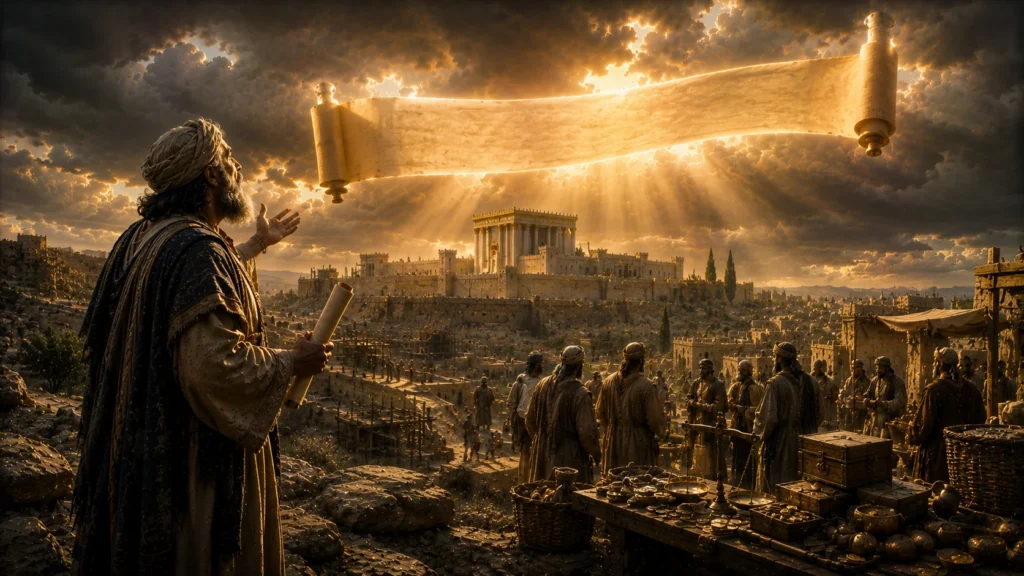
Zechariah 5 begins when the prophet looks up and sees an enormous flying scroll moving through the air.
When the interpreting angel asks Zechariah what he sees, the prophet describes a scroll approximately twenty cubits long and ten cubits wide.
The angel explains that the scroll represents a curse going out over the whole land.
One side addresses those who steal, while the other addresses those who swear falsely. These sins represent violations against both other people and God.
The judgment represented by the scroll will not merely pass over the guilty. God declares that it will enter the house of the thief and the house of the person who falsely swears by His name.
The imagery communicates that wrongdoing cannot remain safely concealed behind private walls. God’s judgment reaches into the places where people may believe their sins are hidden.
Zechariah then receives another vision.
The angel tells him to look again, and Zechariah sees an ephah, a large measuring basket associated with commerce.
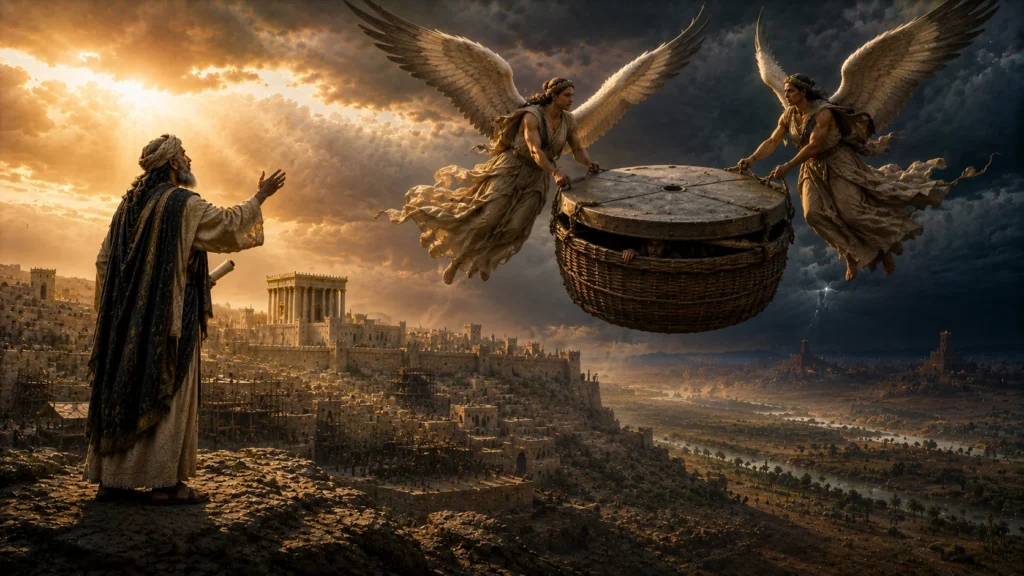
A heavy lead cover is lifted, revealing a woman sitting inside the basket. The angel identifies her symbolically as Wickedness.
The angel pushes her back into the basket and seals its opening with the heavy lead cover, portraying wickedness being restrained.
Zechariah then sees two women approaching through the air with wind in their wings, which are compared to the wings of a stork. They lift the basket and carry it away between earth and heaven.
Zechariah asks where they are taking it.
The angel explains that the basket is being carried to the land of Shinar, an ancient name associated with Babylon. A house will be prepared there for it, and when everything is ready, the basket will be placed upon its base.
The imagery presents a powerful picture of wickedness being removed from the land of God’s people and relocated to a place historically associated with human rebellion.
Zechariah Chapter 5 therefore demonstrates that restoration requires purification. Rebuilding Jerusalem’s walls, homes, and Temple would be incomplete if dishonesty, corruption, falsehood, and rebellion continued unchecked within the community.
God desires not merely a restored city, but a holy people.
Key Lessons – Zechariah Chapter 5
- God sees sins that people attempt to hide.
- The flying scroll enters individual houses, demonstrating that private wrongdoing remains completely visible to God.
- God cares about honesty between people.
- The condemnation of theft reveals that righteousness includes how people treat their neighbors and their possessions.
- God takes His name seriously.
- False swearing by God’s name turns dishonesty into an act of irreverence toward the Lord Himself.
- Restoration requires spiritual purification.
- Rebuilding Jerusalem physically was not enough. God also intended to cleanse His people morally and spiritually.
- Wickedness cannot permanently remain among God’s people.
- The sealed basket portrays evil being restrained and ultimately removed.
- God’s holiness demands accountability.
- The visions remind the restored community that returning from exile did not eliminate their responsibility to obey God.
- Material prosperity must not replace righteousness.
- The ephah was associated with trade and measurement, making the vision especially meaningful in a society rebuilding its economic life.
- God is sovereign over the removal of evil.
- Wickedness is not portrayed as ultimately beyond God’s control. It is confined, sealed, and carried away according to His purpose.
Important Verses
- Zechariah 5:1 — Zechariah looks up and sees a flying scroll.
- Zechariah 5:3 — The angel explains that the scroll represents a curse going throughout the land against thieves and those who swear falsely.
- Zechariah 5:4 — God declares that the curse will enter the houses of those guilty of theft and false swearing.
- Zechariah 5:6 — Zechariah sees an ephah, or measuring basket, representing wickedness within the land.
- Zechariah 5:7–8 — A woman appears inside the basket and is identified symbolically as Wickedness before being confined beneath the heavy lead cover.
- Zechariah 5:9 — Two women with wind in their wings lift the basket and carry it between earth and heaven.
- Zechariah 5:10–11 — Zechariah asks where the basket is being taken, and the angel explains that it is being carried to the land of Shinar.