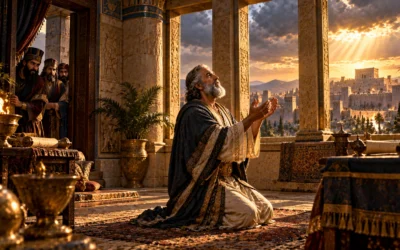

Hosea Chapter 6 presents a powerful call for Israel to return to the Lord, followed by God’s response exposing the shallowness of the people’s repentance. The chapter begins with hopeful words about returning to God, healing, restoration, and living in His presence. Yet God reveals that Israel and Judah’s faithfulness disappears as quickly as morning clouds and dew. Through Hosea, the Lord declares one of the chapter’s central truths: “I desired mercy, and not sacrifice; and the knowledge of God more than burnt offerings.” Hosea 6 teaches that God desires genuine love, faithfulness, repentance, and a real relationship with Him—not religious rituals performed by hearts that remain unchanged.
Hosea Chapter 6 Summary
Hosea Chapter 6 begins with an invitation:
“Come, and let us return unto the LORD.”
The people recognize that the Lord who has allowed them to experience judgment is also able to restore them.
They declare:
“He hath torn, and he will heal us; he hath smitten, and he will bind us up.”
This creates a powerful picture of repentance and restoration.
The same God whose judgment exposes their rebellion is the One who can heal the damage caused by their sin.
The people continue by expressing confidence that God can revive and restore them.
They say:
“After two days will he revive us: in the third day he will raise us up, and we shall live in his sight.”
The language emphasizes the hope of renewed life after judgment and the possibility of restoration in God’s presence.
They then encourage one another to pursue the Lord:
“Then shall we know, if we follow on to know the LORD.”
Knowing God requires more than outward religious activity.
They must genuinely seek Him.
The Lord’s coming is compared to the certainty of the morning and to the refreshing rain that waters the earth.
The opening verses therefore appear filled with hope, repentance, healing, and renewed devotion.
But the tone suddenly changes.
God responds:
“O Ephraim, what shall I do unto thee? O Judah, what shall I do unto thee?”
The problem is that their goodness does not last.
God compares their faithfulness to:
“A morning cloud, and as the early dew it goeth away.”
Like mist that disappears when the sun rises, their devotion quickly vanishes.
They may speak words of repentance, but their history demonstrates that their hearts repeatedly return to rebellion.
Because of this, God has sent prophets to confront them.
His words of judgment cut through their false security.
The Lord declares that His judgments go forth like light.
Then comes the central declaration of Hosea Chapter 6:
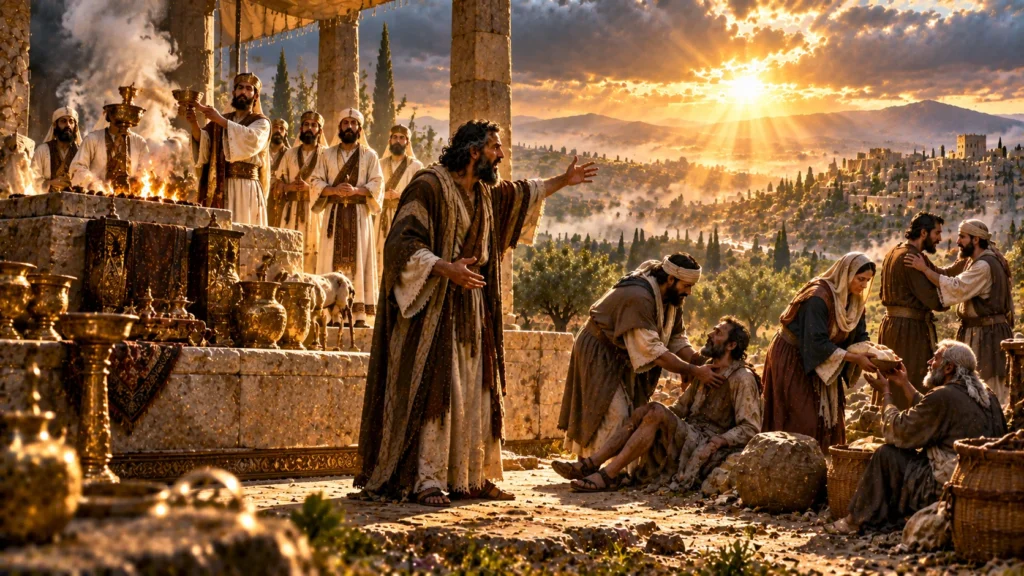
“For I desired mercy, and not sacrifice; and the knowledge of God more than burnt offerings.”
Israel continued practicing religious ceremonies.
They brought sacrifices.
They presented burnt offerings.
They maintained outward expressions of worship.
But God wanted something deeper.
He desired mercy, often understood here as steadfast love, covenant loyalty, faithfulness, and genuine devotion.
He wanted His people truly to know Him.
Sacrifices without faithful hearts could not substitute for a genuine relationship with God.
The chapter then exposes how far Israel has departed from that relationship.
The people have broken the covenant.
Hosea compares their unfaithfulness to Adam’s transgression, though the precise translation of verse 7 can also be understood as breaking the covenant “like men” or “at Adam,” depending on interpretation.
Either way, the central point is clear:
Israel has dealt treacherously with God.
The city of Gilead is described as filled with wrongdoing.
Violence and corruption have contaminated the land.
The spiritual leaders are also condemned.
Hosea compares groups of priests to robbers waiting along a road.
Those who should have helped lead the people toward God have instead participated in terrible wrongdoing.
The corruption is therefore not limited to ordinary citizens.
It has reached people entrusted with spiritual responsibility.
God declares that He has seen a horrible thing within Israel.
Ephraim has committed spiritual unfaithfulness, and Israel has become defiled.
The nation that had been called into covenant relationship with God has repeatedly pursued other gods and rejected His commands.
Yet the chapter does not end without hope.
The final verse turns toward Judah and speaks of an appointed harvest when God restores the captivity, or fortunes, of His people.
The exact nature of this harvest is debated, since harvest imagery can represent either judgment or restoration depending on context.
Nevertheless, the chapter has already established that God’s purpose is not merely punishment.
He desires His people to return and genuinely know Him.
Hosea Chapter 6 therefore reveals a crucial difference between temporary religious emotion and lasting repentance.
Israel could say the right words.
They could offer sacrifices.
They could participate in worship.
But God looked beyond outward appearances and examined their hearts.
The chapter’s message can be summarized:
return → healing → desire to know God → shallow devotion exposed → mercy over ritual → covenant unfaithfulness revealed → call to genuine relationship with God.
Key Lessons – Hosea Chapter 6
- God calls His people to return to Him. Even after rebellion and judgment, the opening invitation is still, “Come, and let us return unto the LORD.”
- God is able to heal what sin has damaged. The Lord who disciplines His people is also able to bind their wounds and restore them.
- Repentance must be more than temporary emotion. Israel’s devotion repeatedly disappears like morning mist and early dew.
- God desires steadfast love more than empty religious ritual. Sacrifices cannot compensate for hearts that remain unfaithful.
- Knowing God is more important than merely practicing religion. Hosea emphasizes genuine relationship with God rather than outward ceremony alone.
- Spiritual leaders are accountable for how they influence others. Hosea strongly condemns priests who participate in corruption instead of guiding people toward righteousness.
- God sees beyond outward appearances. Religious activity may impress other people, but God knows whether devotion is genuine.
- True faithfulness continues after the emotional moment has passed. God desires covenant loyalty that remains rather than devotion that disappears like morning dew.
Important Verses
- Hosea 6:1
- “Come, and let us return unto the LORD: for he hath torn, and he will heal us; he hath smitten, and he will bind us up.”
- Hosea 6:2
- “After two days will he revive us: in the third day he will raise us up, and we shall live in his sight.”
- Hosea 6:3
- “Then shall we know, if we follow on to know the LORD.”
- Hosea 6:4
- “For your goodness is as a morning cloud, and as the early dew it goeth away.”
- Hosea 6:6
- “For I desired mercy, and not sacrifice; and the knowledge of God more than burnt offerings.”
- Hosea 6:7
- “But they like men have transgressed the covenant: there have they dealt treacherously against me.”
- Hosea 6:10
- “I have seen an horrible thing in the house of Israel.”