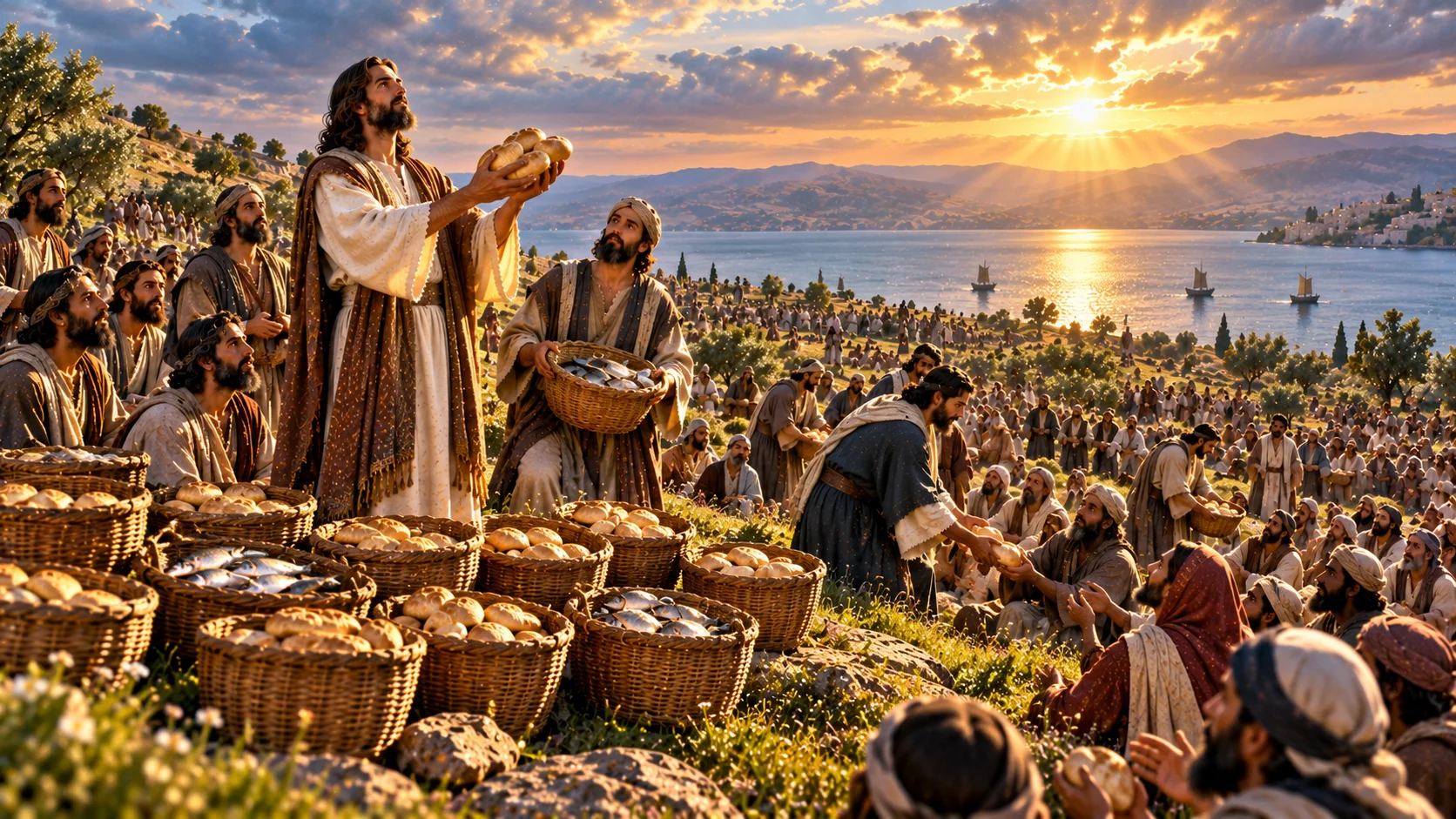
John Chapter 6 is one of the most important chapters in the Gospel of John because it moves from Jesus miraculously providing physical bread to revealing Himself as “the bread of life.” Jesus feeds more than five thousand people with five barley loaves and two small fish, walks across the Sea of Galilee, and then confronts a crowd that seeks Him primarily because they want more food. Jesus teaches that earthly bread can satisfy hunger temporarily, but only He can give eternal life. His teaching becomes increasingly difficult for many listeners, causing numerous disciples to abandon Him. The chapter concludes with Peter’s powerful confession that there is nowhere else to go because Jesus has “the words of eternal life.”
John Chapter 6 Summary
John Chapter 6 begins with Jesus crossing the Sea of Galilee, also called the Sea of Tiberias.
A great multitude follows Him because they have witnessed the miraculous healings He performed.
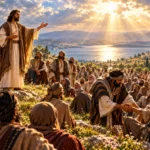
Jesus goes up onto a mountain and sits with His disciples.
John notes that the Passover is approaching.
When Jesus looks up and sees the enormous crowd coming toward Him, He asks Philip:
“Whence shall we buy bread, that these may eat?”
Jesus already knows what He is going to do.
John explains that Jesus asks the question to test Philip.
Philip immediately thinks about the enormous cost.
Even two hundred denarii worth of bread would not be enough to provide everyone with even a small amount.
Andrew then mentions that there is someone present who has:
five barley loaves and two small fish.
But Andrew recognizes how inadequate this appears.
He asks:
“But what are they among so many?”
Jesus tells the disciples:
“Make the men sit down.”
There is plenty of grass in the area.
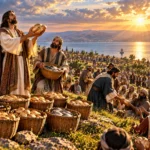
About five thousand men sit down.
Jesus takes the loaves.
He gives thanks.
Then He distributes the bread to the people.
He does the same with the fish.
Everyone receives:
“As much as they would.”
This is not merely a tiny symbolic portion.
The enormous crowd eats until they are satisfied.
Jesus then commands the disciples:
“Gather up the fragments that remain, that nothing be lost.”
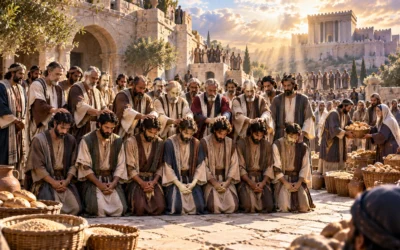
The disciples gather the leftovers.
The five barley loaves have produced enough food to fill twelve baskets with fragments after thousands of people have already eaten.
The people recognize the extraordinary nature of the miracle.
They declare:
“This is of a truth that prophet that should come into the world.”
But their response soon becomes misguided.
Jesus realizes that they intend to take Him forcibly and make Him king.
Rather than allowing the crowd to define His mission according to their political expectations, Jesus withdraws alone into a mountain.
That evening, the disciples go down to the sea.
They enter a boat and begin crossing toward Capernaum.
Darkness falls.
Jesus has not yet joined them.
A strong wind begins blowing.
The sea becomes rough.
After rowing several miles, the disciples suddenly see Jesus:
“Walking on the sea, and drawing nigh unto the ship.”
They are frightened.
Jesus tells them:
“It is I; be not afraid.”
They willingly receive Him into the boat.
John then describes another extraordinary detail:
“Immediately the ship was at the land whither they went.”
The following day, the crowd realizes that Jesus is no longer where He had fed them.
They travel to Capernaum looking for Him.
When they find Jesus, they ask when He arrived.
But Jesus exposes their real motivation.
He tells them they are seeking Him not because they truly understood the signs, but because:
“Ye did eat of the loaves, and were filled.”
They want another meal.
Jesus redirects their attention from temporary physical satisfaction toward eternal realities.
He commands:
“Labour not for the meat which perisheth, but for that meat which endureth unto everlasting life.”
The crowd asks what they must do to perform the works of God.
Jesus responds:
“This is the work of God, that ye believe on him whom he hath sent.”
Despite having just witnessed the multiplication of the loaves, the crowd asks Jesus for another sign.
They refer to Moses and the manna their ancestors received in the wilderness.
Jesus corrects their understanding.
Moses was not the ultimate source of the manna.
God gave the bread.
Jesus then speaks about a greater bread:
“For the bread of God is he which cometh down from heaven, and giveth life unto the world.”
The crowd responds:
“Lord, evermore give us this bread.”
Jesus then makes one of the great declarations in the Gospel of John:
“I am the bread of life.”
He continues:
“He that cometh to me shall never hunger; and he that believeth on me shall never thirst.”
The miracle of the loaves now takes on deeper meaning.
Jesus did not merely come to give bread.
Jesus Himself is the true bread that humanity ultimately needs.
Physical bread sustains temporary life.
Jesus gives eternal life.
Jesus explains that He has come down from heaven not to accomplish His own independent will but:
“The will of him that sent me.”
The Father’s will includes Jesus preserving those who belong to Him and raising them:
“At the last day.”
Jesus repeatedly connects faith in Him with eternal life.
He declares:
“He that believeth on me hath everlasting life.”
Again Jesus says:
“I am that bread of life.”
Israel’s ancestors ate manna in the wilderness.
Yet eventually they died.
Jesus contrasts the manna with Himself.
He is the living bread from heaven.
Those who receive the life He gives will live forever.
Jesus then intensifies His teaching:
“The bread that I will give is my flesh, which I will give for the life of the world.”
His words point forward toward His sacrificial death.
Jesus will give Himself for others.
The listeners begin arguing among themselves.
They ask how Jesus can give them His flesh to eat.
Jesus continues with vivid language about eating His flesh and drinking His blood.
The teaching emphasizes the necessity of personally receiving and depending upon Jesus and the life made possible through His sacrificial death.
He says:
“He that eateth my flesh, and drinketh my blood, dwelleth in me, and I in him.”
Just as physical food must be personally received to sustain physical life, Jesus must be personally received by faith.
Jesus contrasts Himself again with the manna.
Their ancestors ate manna and eventually died.
But:
“He that eateth of this bread shall live for ever.”
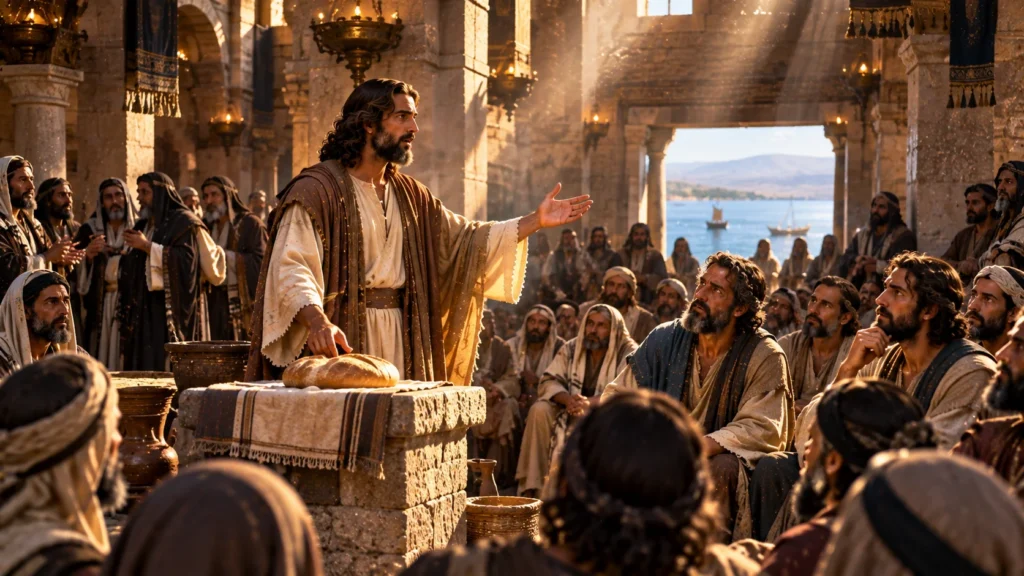
Jesus teaches these things in the synagogue at Capernaum.
Many of His disciples struggle with what they hear.
They say:
“This is an hard saying; who can hear it?”
Jesus knows they are complaining.
He challenges them further and emphasizes the necessity of the Spirit.
He declares:
“It is the spirit that quickeneth; the flesh profiteth nothing.”
He continues:
“The words that I speak unto you, they are spirit, and they are life.”
Jesus also knows that some among them do not truly believe.
John explains that Jesus knew from the beginning who would believe and who would betray Him.
Then comes one of the saddest moments in the chapter:
“From that time many of his disciples went back, and walked no more with him.”
When Jesus’ teaching becomes difficult, many people who had followed Him leave.
Jesus turns toward the twelve.
He asks:
“Will ye also go away?”
Peter responds with one of the most powerful confessions in the Gospel:
“Lord, to whom shall we go? thou hast the words of eternal life.”
Peter continues:
“And we believe and are sure that thou art that Christ, the Son of the living God.”
The twelve remain.
Yet Jesus reveals that even among them there is one who will betray Him.
John identifies him as Judas Iscariot.
John Chapter 6 therefore presents a dramatic progression:
physical hunger → miraculous bread → Jesus walks on water → crowd seeks more bread → Jesus reveals the Bread of Life → difficult teaching → many disciples leave → Peter chooses to remain.
The chapter ultimately forces every listener to confront the same question Jesus asked the twelve:
Will you follow Jesus only when He gives you what you want, or will you remain with Him because you recognize that He alone has the words of eternal life?
Key Lessons – John Chapter 6
- Jesus can provide abundantly from what appears insufficient. Five barley loaves and two small fish become enough to satisfy thousands with twelve baskets remaining.
- Jesus refuses to let people redefine His mission. When the crowd attempts to make Him king according to their expectations, He withdraws.
- Jesus has authority over creation. His walking upon the Sea of Galilee demonstrates authority over forces completely beyond human control.
- People can seek Jesus for the wrong reasons. The crowd follows Him because they want more bread, while Jesus wants them to understand what the miracle reveals about Him.
- Faith in Jesus is central to eternal life. Jesus says that the work God requires is to believe in the One He has sent.
- Jesus is the Bread of Life. Physical food temporarily satisfies hunger, but Christ provides the spiritual and eternal life humanity ultimately needs.
- Jesus gave Himself for the life of the world. His teaching about His flesh points toward the sacrifice He will make through His death.
- True discipleship continues even when Jesus’ teaching becomes difficult. Many followers leave when His words challenge them.
- Jesus knows the hearts of His followers. He knows genuine believers as well as those who will ultimately reject or betray Him.
- There is nowhere better to go than Jesus. Peter’s response summarizes genuine faith: “Lord, to whom shall we go? thou hast the words of eternal life.”
Important Verses
- John 6:11
- “And Jesus took the loaves; and when he had given thanks, he distributed to the disciples.”
- John 6:12
- “When they were filled, he said unto his disciples, Gather up the fragments that remain, that nothing be lost.”
- John 6:20
- “But he saith unto them, It is I; be not afraid.”
- John 6:27
- “Labour not for the meat which perisheth, but for that meat which endureth unto everlasting life.”
- John 6:29
- “This is the work of God, that ye believe on him whom he hath sent.”
- John 6:35
- “I am the bread of life: he that cometh to me shall never hunger; and he that believeth on me shall never thirst.”
- John 6:40
- “Every one which seeth the Son, and believeth on him, may have everlasting life.”
- John 6:47
- “Verily, verily, I say unto you, He that believeth on me hath everlasting life.”
- John 6:48
- “I am that bread of life.”
- John 6:51
- “I am the living bread which came down from heaven.”
- John 6:63
- “The words that I speak unto you, they are spirit, and they are life.”
- John 6:66
- “From that time many of his disciples went back, and walked no more with him.”
- John 6:68
- “Lord, to whom shall we go? thou hast the words of eternal life.”