
Romans Chapter 6 explains one of the most important consequences of salvation through Jesus Christ: grace does not give believers permission to continue living under the control of sin. Paul teaches that those who belong to Christ have been united with Him in His death and resurrection. Their old life under sin’s dominion has been judged, and they are called to walk in “newness of life.” Paul uses baptism to illustrate this union with Christ and then contrasts two kinds of slavery: slavery to sin, which leads to death, and willing obedience to God, which leads toward righteousness and holiness. The chapter ends with one of the clearest summaries of the gospel’s contrast between sin and grace: “the wages of sin is death; but the gift of God is eternal life through Jesus Christ our Lord.”
Romans Chapter 6 Summary
Romans Chapter 6 begins with a question that naturally follows Paul’s teaching about the abundance of God’s grace.
Paul asks:
“Shall we continue in sin, that grace may abound?”
If grace increases where sin increases, should believers deliberately continue sinning so that even more grace can be displayed?
Paul responds emphatically:
“God forbid.”
Grace is not permission to remain enslaved to sin.
Paul asks how people who have died to sin can continue living as though sin still owns them.
He then points toward baptism.
Those baptized into Jesus Christ have been baptized into His death.
Paul writes:
“Therefore we are buried with him by baptism into death.”
But death is not the end of the picture.
Just as Christ was raised from the dead through the glory of the Father, believers are called to:
“Walk in newness of life.”
Paul describes an extraordinary spiritual union between Christ and His people.
Those united with Christ in the likeness of His death will also share in the likeness of His resurrection.
The believer’s “old man” has been crucified with Christ.
This means the former identity dominated by sin no longer has the same claim of ownership.
Paul explains that this happened:
“That the body of sin might be destroyed, that henceforth we should not serve sin.”
The emphasis is liberation.
Sin is portrayed as a cruel master.
Through Christ, believers are being freed from its dominion.
Paul then turns toward the resurrection.
Christ was raised from the dead and:
“Dieth no more.”
Death no longer has dominion over Him.
Christ died to sin once.
Now He lives unto God.
Paul tells believers to understand themselves in light of what Christ has accomplished.
They should:
“Reckon ye also yourselves to be dead indeed unto sin, but alive unto God through Jesus Christ our Lord.”
This does not mean believers become incapable of temptation or sin.
Instead, they must recognize that sin no longer has the rightful authority to rule them.
Paul therefore commands:
“Let not sin therefore reign in your mortal body.”
Sin should no longer sit upon the throne of a believer’s life.
Believers should not surrender the members of their bodies to sin as:
“Instruments of unrighteousness.”
Instead, they should present themselves to God as people who have been brought from death into life.
Their bodies should become:
“Instruments of righteousness unto God.”
Hands, feet, minds, words, abilities, resources, and actions that were once used in service to sin can now be offered in service to God.
Paul then makes a powerful declaration:
“For sin shall not have dominion over you.”
Why?
“For ye are not under the law, but under grace.”
Again Paul anticipates a misunderstanding.
If believers are under grace rather than law, does that mean sin no longer matters?
He asks:
“Shall we sin, because we are not under the law, but under grace?”
Again the answer is:
“God forbid.”
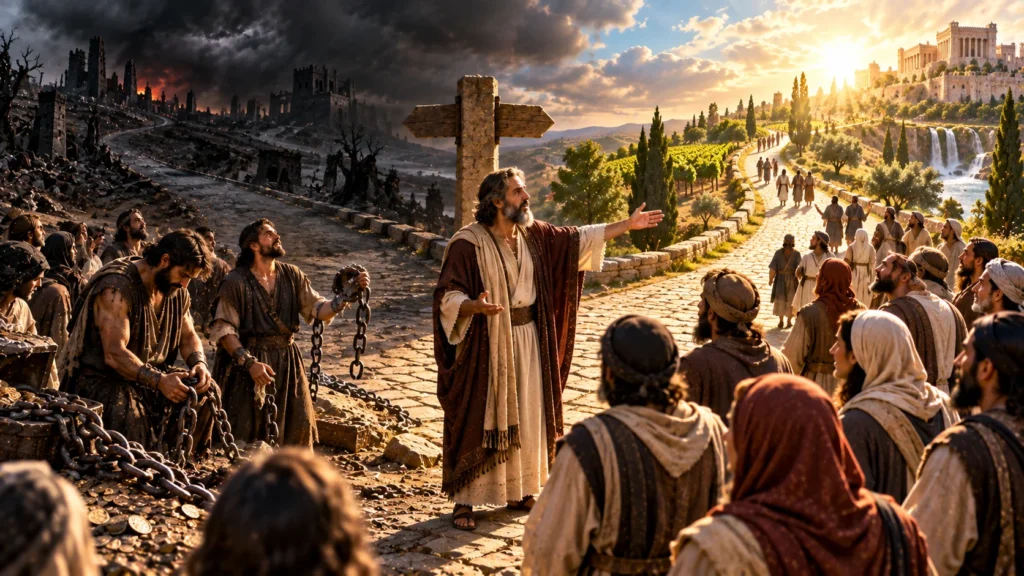
Paul then introduces the imagery of slavery.
A person becomes the servant of the master he continually obeys.
Paul presents two opposing masters:
sin and obedience to God.
Sin leads toward death.
Obedience leads toward righteousness.
Paul reminds the Roman believers that they were once:
“The servants of sin.”
But something has changed.
They have:
“Obeyed from the heart that form of doctrine which was delivered you.”
Their transformation is not merely external religious behavior.
Their obedience comes from the heart.
Paul declares:
“Being then made free from sin, ye became the servants of righteousness.”
Freedom in Christ does not mean living without any master or purpose.
Christ frees people from the destructive mastery of sin so they can belong wholeheartedly to God.
Paul acknowledges that he is using human imagery—slavery—to help explain a spiritual reality.
He reminds them that they previously presented themselves to impurity and lawlessness.
Sin continually produced more sin.
Now they should present themselves as servants of righteousness:
“Unto holiness.”
Paul asks them to remember what their former slavery actually produced.
When they were servants of sin, they were free from righteousness.
But what lasting benefit did those things produce?
Paul asks:
“What fruit had ye then in those things whereof ye are now ashamed?”
The ultimate outcome was:
“Death.”
But everything changes when a person is freed from sin and belongs to God.
Paul writes:
“Ye have your fruit unto holiness, and the end everlasting life.”
The chapter then concludes with one of Scripture’s clearest contrasts between what sin earns and what God freely gives:
“For the wages of sin is death; but the gift of God is eternal life through Jesus Christ our Lord.”
The contrast is deliberate.
Wages are earned.
A gift is received.
Sin pays wages.
Those wages are death.
God offers something completely different that human beings could never earn for themselves:
eternal life through Jesus Christ.
Romans Chapter 6 therefore presents a powerful progression:
grace → union with Christ → death to the old life → resurrection → newness of life → freedom from sin’s dominion → service to righteousness → holiness → eternal life.
Paul’s message is not simply:
“Try harder not to sin.”
His message begins with something far deeper:
Remember who you now are because you belong to Christ.
The believer fights sin from the position of someone who has been united with the crucified and risen Jesus and is now called to live accordingly.
Key Lessons – Romans Chapter 6
- God’s grace is never permission to continue deliberately living in sin. Paul immediately rejects the idea that more sin is desirable because it produces opportunities for more grace.
- Believers are united with Jesus Christ in His death and resurrection. Christ’s death and resurrection fundamentally change the believer’s relationship with sin, death, and God.
- Baptism pictures death, burial, and resurrection with Christ. The old life is left behind so that the believer can walk in newness of life.
- Sin no longer has the rightful authority to dominate those who belong to Christ. Believers still face temptation, but they are no longer to recognize sin as their master.
- Christians must actively refuse to let sin reign. Paul commands believers not to surrender their bodies as instruments of unrighteousness.
- Our lives should be presented completely to God. The same bodies once used for sinful purposes can become instruments of righteousness.
- Grace produces transformation rather than lawlessness. Being under grace does not make obedience unnecessary; grace liberates people so they can genuinely serve God.
- Everyone ultimately serves a master. Paul contrasts slavery to sin with willing service to righteousness and God.
- Sin promises freedom but produces shame and death. Paul asks believers to remember the fruit produced by their former way of life.
- Eternal life cannot be earned as wages. Sin earns death, but eternal life is God’s gift received through Jesus Christ our Lord.
Important Verses
- Romans 6:1–2
- “Shall we continue in sin, that grace may abound? God forbid.”
- Romans 6:4
- “Therefore we are buried with him by baptism into death… even so we also should walk in newness of life.”
- Romans 6:6
- “Knowing this, that our old man is crucified with him… that henceforth we should not serve sin.”
- Romans 6:8
- “Now if we be dead with Christ, we believe that we shall also live with him.”
- Romans 6:11
- “Reckon ye also yourselves to be dead indeed unto sin, but alive unto God through Jesus Christ our Lord.”
- Romans 6:12
- “Let not sin therefore reign in your mortal body.”
- Romans 6:13
- “Yield yourselves unto God, as those that are alive from the dead, and your members as instruments of righteousness unto God.”
- Romans 6:14
- “For sin shall not have dominion over you: for ye are not under the law, but under grace.”
- Romans 6:18
- “Being then made free from sin, ye became the servants of righteousness.”
- Romans 6:22
- “Ye have your fruit unto holiness, and the end everlasting life.”
- Romans 6:23
- “For the wages of sin is death; but the gift of God is eternal life through Jesus Christ our Lord.”