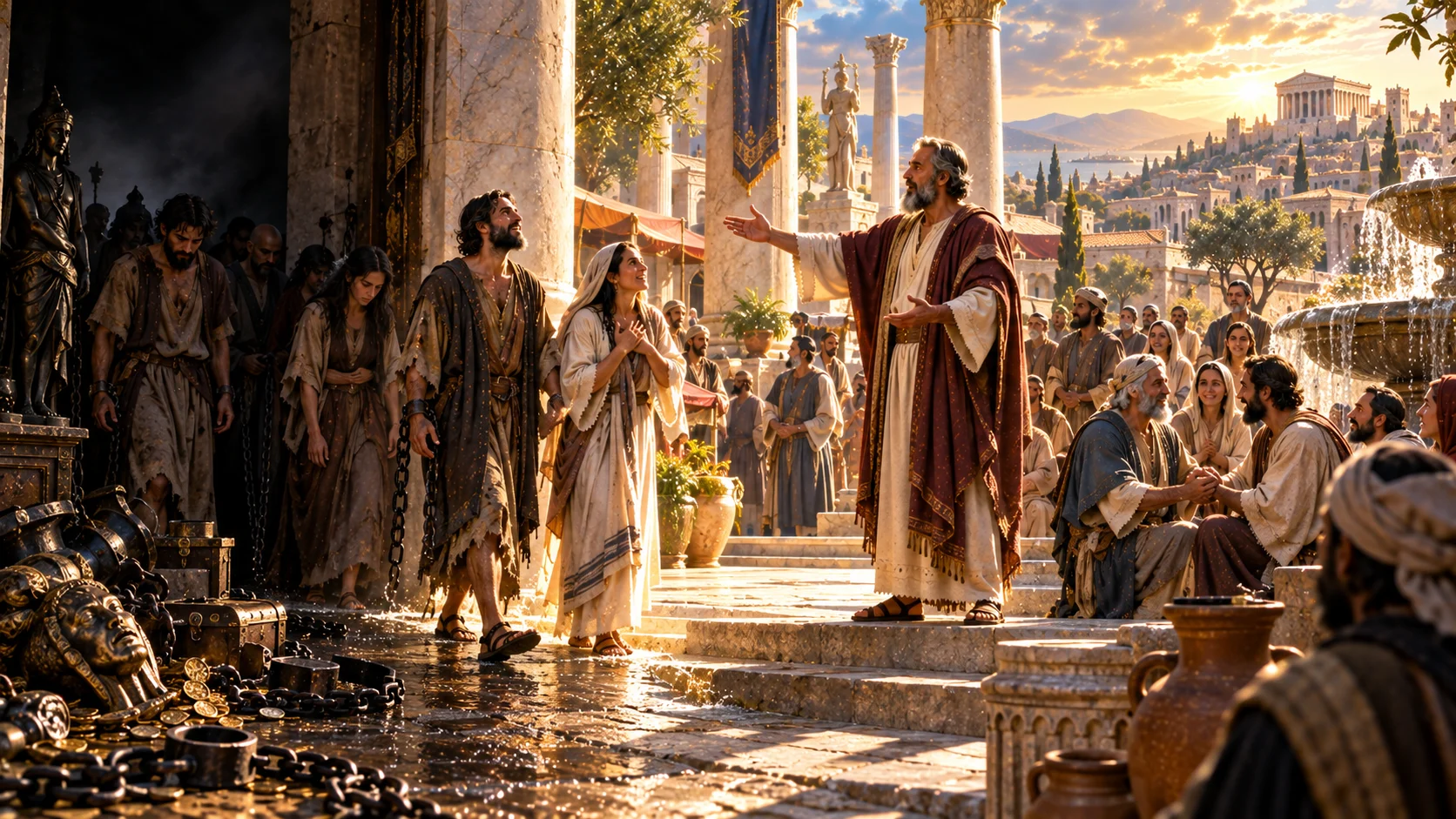
1 Corinthians Chapter 6 addresses three major issues affecting the church at Corinth: lawsuits between believers, misunderstanding Christian freedom, and sexual immorality. Paul rebukes Christians who are taking one another before secular courts instead of resolving disputes with wisdom within the church. He then warns that persistent unrighteous living is incompatible with the kingdom of God, while reminding the Corinthians of the dramatic transformation they have already experienced through Jesus Christ: “ye are washed… ye are sanctified… ye are justified.” Paul concludes by teaching that the believer’s body belongs to Christ and is a temple of the Holy Ghost. Christians therefore are not their own; they have been “bought with a price” and are called to glorify God with both body and spirit.
1 Corinthians Chapter 6 Summary
1 Corinthians Chapter 6 begins with Paul confronting a serious problem within the Corinthian church.
Believers are having disputes with one another.
Instead of settling these disagreements within the Christian community, some are taking fellow believers before secular courts.
Paul asks:
“Dare any of you, having a matter against another, go to law before the unjust, and not before the saints?”
Paul is astonished.
The church has been entrusted with tremendous spiritual responsibility, yet its members apparently cannot resolve relatively ordinary disagreements among themselves.
Paul reminds them:
“Do ye not know that the saints shall judge the world?”
His argument moves from the greater responsibility to the lesser.
If believers will participate in God’s future judgment, surely they should be capable of handling ordinary disputes in the present.
Paul even says:
“Know ye not that we shall judge angels?”
If this is true, then:
“How much more things that pertain to this life?”
Paul challenges the Corinthians’ priorities.
They boast about spiritual knowledge and wisdom, yet their conflicts suggest that they are failing to practice that wisdom.
He asks whether there is really:
“Not a wise man among you?”
Surely someone within the church should be capable of judging fairly between fellow believers.
Instead:
“Brother goeth to law with brother.”
And they do this before unbelievers.
For Paul, the problem is larger than simply choosing the wrong courtroom.
The lawsuits reveal damaged relationships and misplaced priorities.
He tells them:
“Now therefore there is utterly a fault among you, because ye go to law one with another.”
Paul then asks two challenging questions:
“Why do ye not rather take wrong? why do ye not rather suffer yourselves to be defrauded?”
The Corinthians are fighting to protect their personal rights.
Paul challenges them to consider whether preserving Christian unity and testimony may sometimes be more important than insisting upon winning every dispute.
Worse still, some believers are not merely being wronged.
They themselves are committing wrong.
Paul says:
“Nay, ye do wrong, and defraud, and that your brethren.”
This leads Paul into a broader warning about unrighteousness.
He asks:
“Know ye not that the unrighteous shall not inherit the kingdom of God?”
He warns them:
“Be not deceived.”
Paul then lists patterns of sinful behavior inconsistent with life under God’s rule, including sexual immorality, idolatry, adultery, theft, greed, drunkenness, abusive speech, and extortion.
The point is not that anyone who has ever committed one of these sins is beyond salvation.
Paul immediately reminds the Corinthians that many of them once lived in precisely these ways.
He declares:
“And such were some of you.”
That word “were” is crucial.
Their past does not have to define their future.
Something extraordinary has happened through Christ.
Paul continues:
“But ye are washed.”
“But ye are sanctified.”
“But ye are justified in the name of the Lord Jesus, and by the Spirit of our God.”
The Corinthians have received a new identity.
They have been cleansed.
They have been set apart for God.
They have been declared righteous through Jesus Christ.
Therefore, their present lives should increasingly reflect what God has already done for them.
Paul then addresses another misunderstanding circulating in Corinth.
He quotes or responds to the idea:
“All things are lawful unto me.”
Christian freedom is real, but freedom does not mean that everything is beneficial.
Paul responds:
“All things are not expedient.”
Even more importantly, Paul refuses to become enslaved by anything:
“I will not be brought under the power of any.”
Something may promise freedom while gradually becoming a master.
Christian freedom is therefore not the freedom to be controlled by appetite.
It is freedom to belong fully to Christ.
Paul then addresses the body.
Some Corinthians apparently treat physical appetites as though they are spiritually insignificant.
Paul rejects that idea.
He declares:
“Now the body is not for fornication, but for the Lord; and the Lord for the body.”
The human body matters to God.
Christian faith is not merely concerned with an invisible soul.
Paul points directly toward resurrection.
God raised Jesus from the dead, and:
“Will also raise up us by his own power.”
The future resurrection of the body gives tremendous significance to how believers use their bodies now.
Paul asks:
“Know ye not that your bodies are the members of Christ?”
This creates a powerful ethical reality.
The believer does not belong to Christ merely during prayer, worship, or religious activity.
The believer’s physical body belongs to Christ.
Paul therefore strongly rejects sexual immorality.
He commands:
“Flee fornication.”
Paul does not tell the Corinthians to negotiate with sexual temptation or see how close they can come without falling.
He tells them to flee.
He explains that sexual sin has a uniquely intimate relationship with the body.
Then Paul gives one of the chapter’s greatest revelations concerning the believer’s identity:
“Know ye not that your body is the temple of the Holy Ghost which is in you?”
Under the old covenant, God’s Temple was regarded as sacred because it was associated with His presence.
Paul now applies temple imagery to believers.
The Holy Spirit dwells within them.
Their bodies therefore cannot be treated as meaningless possessions available for whatever desires arise.
Paul continues:
“Ye are not your own.”
This statement reaches the heart of the chapter.
The Christian belongs to someone else.
Why?
“For ye are bought with a price.”
The price points toward the sacrificial work of Jesus Christ.
Christ has redeemed His people at tremendous cost.
Paul therefore concludes:
“Therefore glorify God in your body, and in your spirit, which are God’s.”
Everything belongs to Him.
The believer’s relationships belong to Him.
The believer’s freedom belongs to Him.
The believer’s body belongs to Him.
The believer’s sexuality belongs to Him.
The believer’s entire life is meant to glorify Him.
1 Corinthians Chapter 6 therefore presents a powerful progression:
conflict between believers → lawsuits → willingness to surrender personal rights → warning against unrighteous living → transformed identity in Christ → responsible Christian freedom → the body belongs to Christ → flee sexual immorality → temple of the Holy Spirit → bought with a price → glorify God.
Paul’s message is ultimately about identity and ownership.
Christians do not pursue holiness merely because they have been given a list of rules.
They pursue holiness because they have been washed, sanctified, justified, united with Christ, indwelt by the Holy Spirit, and purchased by God at a tremendous price.
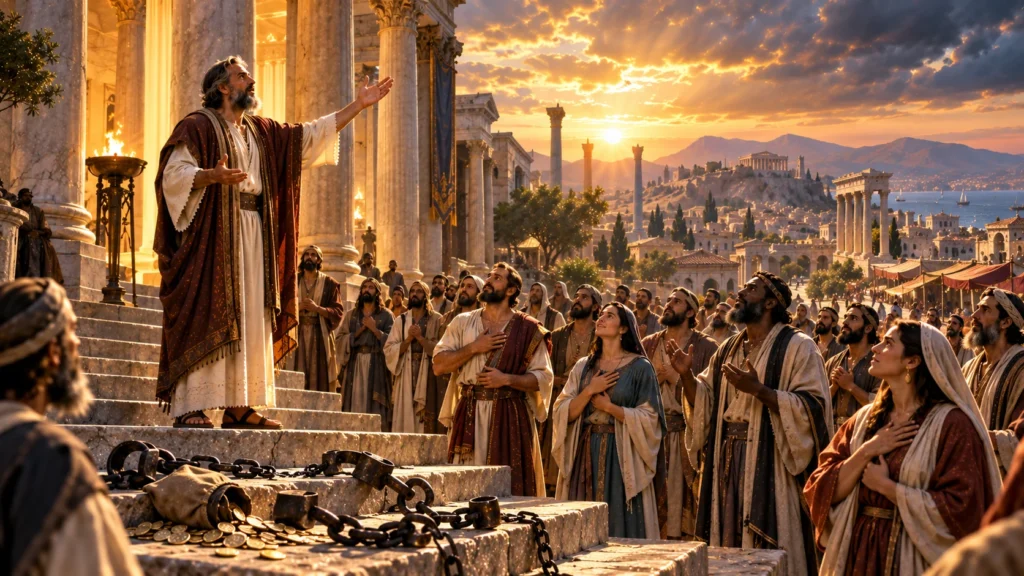
Key Lessons – 1 Corinthians Chapter 6
- Christians should seek wise and peaceful solutions to disputes. Paul rebukes believers for publicly fighting one another instead of pursuing reconciliation and godly wisdom.
- Winning is not always the highest Christian priority. Paul challenges believers to consider whether it may sometimes be better to accept personal loss than damage Christian unity and testimony.
- Persistent unrighteousness should never be treated casually. Paul warns the Corinthians not to deceive themselves concerning lifestyles that contradict God’s kingdom.
- A believer’s past does not have to determine the future. Paul says, “And such were some of you,” before reminding them that they have been washed, sanctified, and justified.
- Salvation gives believers a new identity. Christians should increasingly live according to who they have become through Jesus Christ.
- Christian freedom requires wisdom and self-control. Something being permissible does not automatically make it beneficial.
- True freedom means refusing to become enslaved by anything. Paul declares that he will not allow anything to gain mastery over him.
- The physical body matters to God. The body belongs to the Lord and will ultimately participate in resurrection.
- Believers should flee sexual immorality rather than entertain it. Paul gives a direct command to create distance from sexual sin.
- The believer’s body is a temple of the Holy Spirit. God’s indwelling presence gives extraordinary dignity and responsibility to how Christians use their bodies.
- Christians are not their own. They have been “bought with a price.”
- The purpose of Christian life is to glorify God. Body and spirit ultimately belong to Him.
Important Verses
- 1 Corinthians 6:7
- “Why do ye not rather take wrong? why do ye not rather suffer yourselves to be defrauded?”
- 1 Corinthians 6:9
- “Know ye not that the unrighteous shall not inherit the kingdom of God? Be not deceived.”
- 1 Corinthians 6:11
- “And such were some of you: but ye are washed, but ye are sanctified, but ye are justified in the name of the Lord Jesus, and by the Spirit of our God.”
- 1 Corinthians 6:12
- “All things are lawful unto me, but all things are not expedient… I will not be brought under the power of any.”
- 1 Corinthians 6:13
- “Now the body is not for fornication, but for the Lord; and the Lord for the body.”
- 1 Corinthians 6:14
- “And God hath both raised up the Lord, and will also raise up us by his own power.”
- 1 Corinthians 6:15
- “Know ye not that your bodies are the members of Christ?”
- 1 Corinthians 6:18
- “Flee fornication.”
- 1 Corinthians 6:19
- “What? know ye not that your body is the temple of the Holy Ghost which is in you… and ye are not your own?”
- 1 Corinthians 6:20
- “For ye are bought with a price: therefore glorify God in your body, and in your spirit, which are God’s.”