






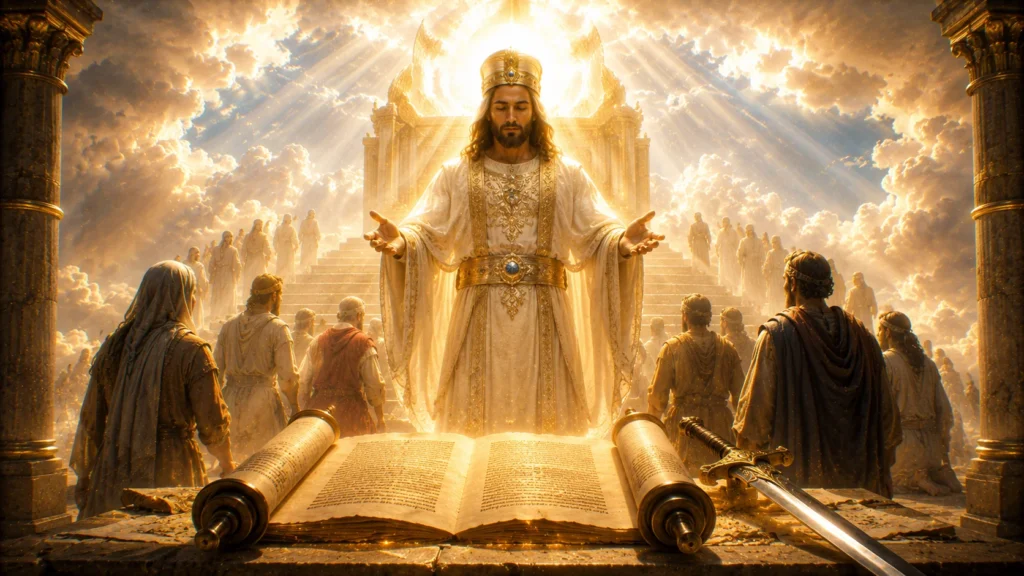


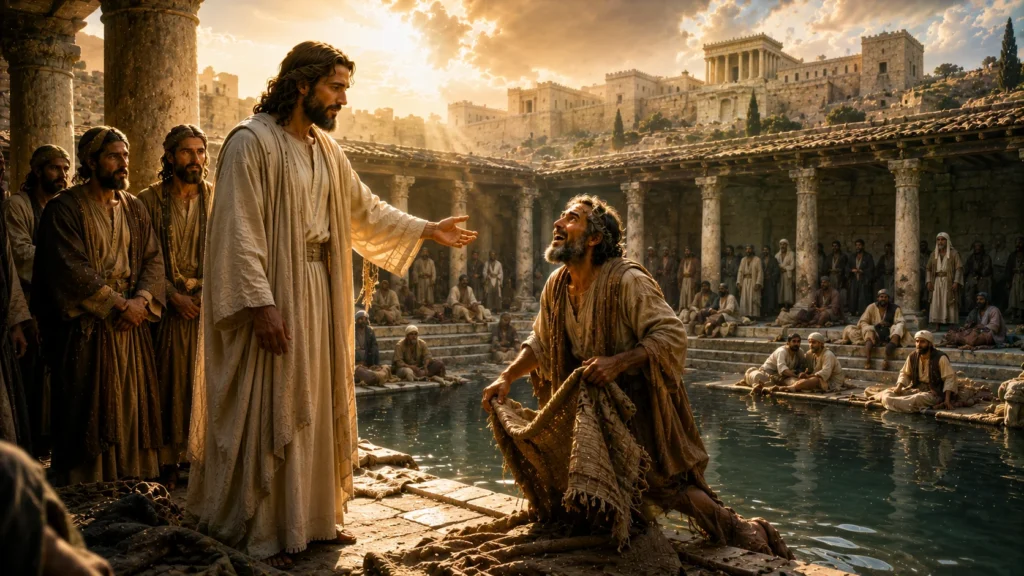

Luke Chapter 5 reveals the growing authority and ministry of Jesus Christ through miraculous provision, healing, forgiveness, and His call for people to follow Him. The chapter begins with the miraculous catch of fish, where Simon Peter encounters the overwhelming power of Jesus and is called to become a fisher of men.
Jesus then cleanses a man with leprosy, heals a paralyzed man while declaring his sins forgiven, and calls Levi the tax collector to become His disciple. The chapter concludes with Jesus responding to questions about fasting and using the illustrations of a new garment and new wine to show that His ministry represents something that cannot simply be fitted into old religious expectations. Throughout Luke 5, Jesus demonstrates divine authority while extending grace to ordinary, suffering, and rejected people.
Luke Chapter 5 Summary
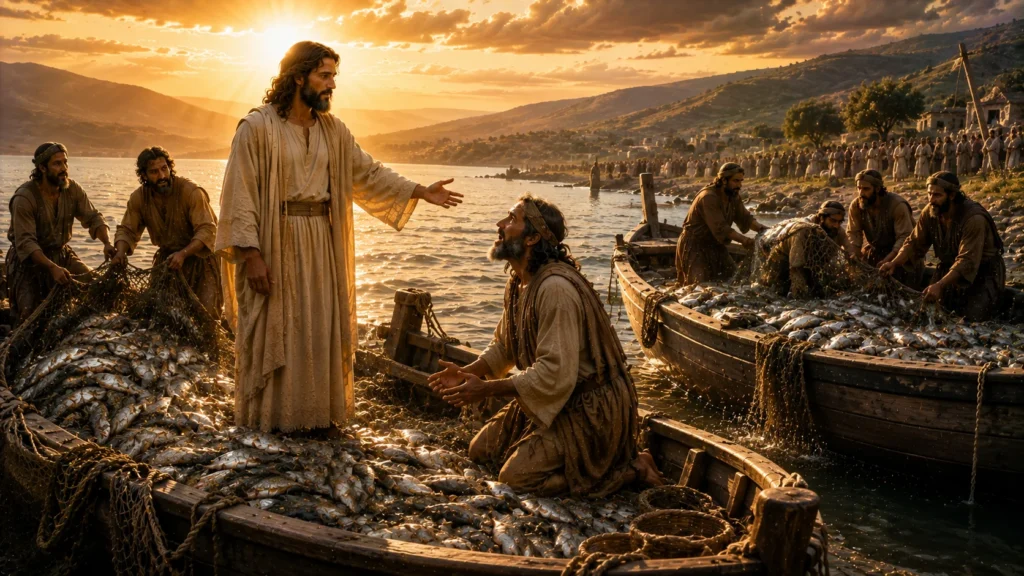
Luke 5 begins beside the Lake of Gennesaret, another name for the Sea of Galilee. A large crowd gathers around Jesus to hear the Word of God.
Jesus sees two fishing boats along the shore and enters the boat belonging to Simon Peter. After teaching the crowd from the boat, Jesus tells Simon to move into deeper water and lower his nets.
Simon explains that he and the other fishermen have worked throughout the night without catching anything. Nevertheless, because Jesus has spoken, Simon obeys.
The result is astonishing.
They catch such an enormous number of fish that their nets begin to break. They signal to their partners in the other boat for help, and both boats become so full that they begin to sink.
Overwhelmed by what he has witnessed, Simon Peter falls before Jesus and acknowledges his own sinfulness.
Jesus responds:
“Fear not; from henceforth thou shalt catch men.”
Simon, James, and John bring their boats to shore, leave everything, and follow Jesus.
Luke then records Jesus encountering a man covered with leprosy. The man falls before Him and declares that if Jesus is willing, He can make him clean.
Jesus reaches out and touches him, saying that He is willing.
Immediately, the disease leaves the man.
As reports about Jesus spread, enormous crowds gather to hear Him and receive healing. Yet Luke makes an important observation: Jesus regularly withdraws into the wilderness to pray.
The next major event takes place inside a crowded house.
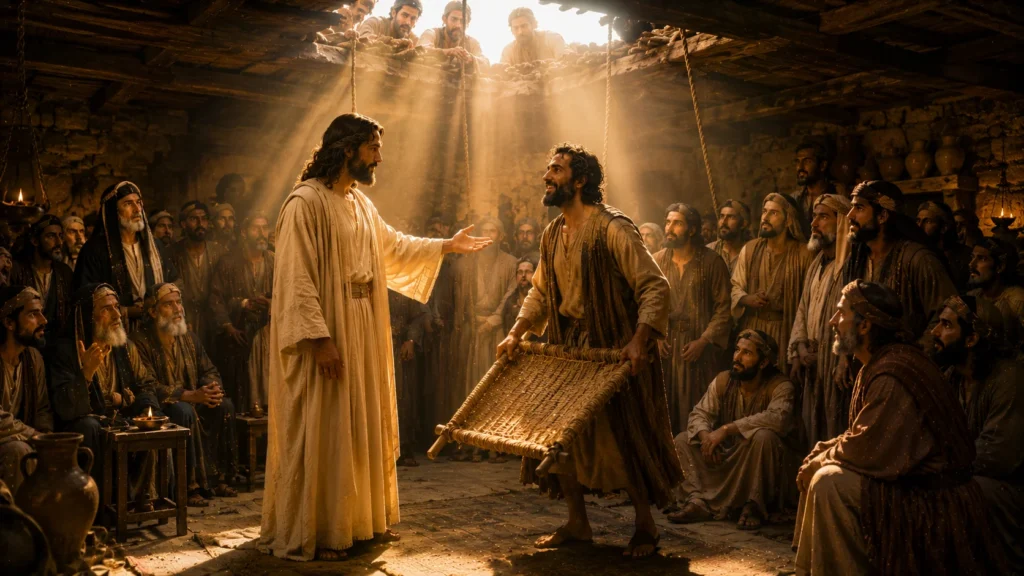
Pharisees and teachers of the law are present while Jesus teaches. Several men arrive carrying a paralyzed man, but the crowd prevents them from reaching Jesus.
They climb onto the roof, remove part of it, and lower the man on his bed directly into the room before Christ.
Seeing their faith, Jesus tells the man:
“Man, thy sins are forgiven thee.”
The religious leaders immediately question this statement because they recognize that forgiveness of sins ultimately belongs to God.
Knowing their thoughts, Jesus asks whether it is easier to declare someone’s sins forgiven or to command a paralyzed man to rise and walk.
To demonstrate that the Son of Man has authority on earth to forgive sins, Jesus commands the man to rise, pick up his bed, and return home.
Immediately, the man stands, takes his bed, and leaves while glorifying God.
The witnesses are astonished and praise God for what they have seen.
Jesus later encounters a tax collector named Levi, also known as Matthew, sitting at his tax booth.
Jesus simply tells him:
“Follow me.”
Levi leaves everything and follows Him.
He then hosts a large banquet for Jesus, attended by many tax collectors and others. The Pharisees and scribes complain because Jesus eats with people they consider sinners.
Jesus responds with one of the chapter’s most important statements:
“They that are whole need not a physician; but they that are sick.”
He explains that He has not come to call the righteous, but sinners to repentance.
The chapter concludes with questions about fasting.
Jesus compares His presence with His disciples to a bridegroom being with wedding guests. He explains that a time will come when the bridegroom is taken away, and then His followers will fast.
Jesus then gives two illustrations.
A piece of new cloth should not be used improperly to repair an old garment, and new wine should not be placed into old wineskins because the expanding wine will burst them.
Through these illustrations, Jesus shows that the new work of God’s kingdom cannot simply be forced into existing religious expectations.
Luke Chapter 5 therefore presents Jesus as the One who calls ordinary people, cleanses the unclean, forgives sinners, heals the helpless, welcomes the rejected, and calls people to leave their former lives and follow Him.
Key Lessons – Luke Chapter 5
- Obedience to Jesus matters even when circumstances appear hopeless.
- Peter had fished throughout the night without success, yet obeying Jesus produced an extraordinary result.
- Encountering Christ’s greatness should produce humility.
- Peter’s response to the miraculous catch was not pride but recognition of his own sinfulness.
- Jesus calls ordinary people to extraordinary purposes.
- Fishermen became disciples who would eventually carry the gospel to others.
- Jesus shows compassion toward those society rejects.
- By touching and cleansing the man with leprosy, Jesus demonstrated both authority and compassion.
- Prayer remained essential to Jesus’ ministry.
- Despite increasing crowds and demands, Jesus deliberately withdrew to pray.
- Faith sometimes requires determined action.
- The friends of the paralyzed man refused to allow obstacles to prevent them from bringing him to Jesus.
- Jesus possesses authority to forgive sins.
- The healing of the paralyzed man visibly confirms Christ’s claim to spiritual authority.
- Following Jesus requires willingness to leave the old life behind.
- Peter and the fishermen leave their boats, while Levi leaves his tax booth.
- Jesus welcomes sinners and calls them toward repentance.
- His association with tax collectors was not approval of sin but part of His mission to bring spiritually sick people toward restoration.
- Life with Christ cannot simply be added to an unchanged old way of living.
- The illustrations of the garment and wineskins point toward the transforming newness associated with Jesus and His kingdom.
Important Verses
- Luke 5:5 — Simon tells Jesus that they have worked all night without catching anything, yet because Jesus has spoken, he will lower the net.
- Luke 5:8 — Peter falls before Jesus after the miraculous catch and acknowledges his own sinfulness.
- Luke 5:10 — Jesus tells Simon, “Fear not; from henceforth thou shalt catch men.”
- Luke 5:11 — Simon, James, and John bring their boats to land, leave everything, and follow Jesus.
- Luke 5:13 — Jesus compassionately touches the man with leprosy and immediately cleanses him.
- Luke 5:16 — “And he withdrew himself into the wilderness, and prayed.”
- Luke 5:20 — Seeing their faith, Jesus tells the paralyzed man that his sins are forgiven.
- Luke 5:24–25 — Jesus demonstrates His authority to forgive sins by commanding the paralyzed man to rise, take his bed, and return home.
- Luke 5:27–28 — Jesus calls Levi from his tax booth, and Levi leaves everything to follow Him.
- Luke 5:31–32 — Jesus explains that healthy people do not need a physician but the sick, and that He came to call sinners to repentance.
- Luke 5:36–38 — Jesus uses the illustrations of a new garment and new wine in wineskins to explain the newness of His ministry.