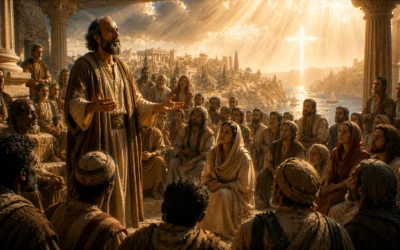

Ecclesiastes Chapter 1 introduces the reflections of Solomon, referred to as “the Preacher.” Looking at life from an earthly perspective, Solomon examines human effort, wisdom, and achievement. He concludes that life without God’s eternal perspective is ultimately empty and temporary. The chapter challenges readers to seek meaning beyond worldly pursuits.
Ecclesiastes Chapter 1 Summary
Ecclesiastes Chapter 1 begins with Solomon declaring one of the most famous statements in Scripture: “Vanity of vanities; all is vanity.” The word vanity refers to something temporary, fleeting, or unable to provide lasting satisfaction. Solomon observes that many of the things people spend their lives pursuing ultimately fail to bring enduring meaning.
He asks what profit a person gains from all their labor under the sun. Generation after generation comes and goes, yet the earth remains. Solomon notes the repetitive cycles of nature—the sun rises and sets, the wind continually circulates, and rivers flow into the sea without ever filling it completely. These cycles illustrate the seemingly endless repetition of life.
Solomon also observes that human desires are never fully satisfied. The eye is never filled with seeing, nor the ear with hearing. People constantly seek new experiences, possessions, and accomplishments, yet lasting fulfillment remains elusive.
The Preacher remarks that there is nothing truly new under the sun. Human history repeats many of the same patterns, and even great achievements are eventually forgotten by future generations. Fame, success, and worldly accomplishments prove temporary when viewed through the lens of time.
Solomon then explains that God gave him extraordinary wisdom. As king over Israel in Jerusalem, he devoted himself to understanding life and everything done under heaven. Despite gaining great knowledge, he discovered that wisdom alone could not solve all of life’s mysteries or eliminate its frustrations.
The more Solomon learned, the more aware he became of the brokenness and limitations of the world. He concludes that increased knowledge often brings increased sorrow because wisdom reveals how much is beyond human control.
Ecclesiastes Chapter 1 teaches that earthly pursuits, wisdom, wealth, and achievement cannot provide ultimate meaning apart from God. True purpose is found not in temporary accomplishments but in a relationship with the eternal Creator.

Key Lessons From Ecclesiastes 1
- Earthly success cannot provide lasting fulfillment.
- Human life is temporary, but God is eternal.
- Worldly achievements eventually fade with time.
- Wisdom reveals both truth and human limitations.
- Lasting meaning is found in God rather than earthly pursuits.
Important Verses
- Ecclesiastes 1:2 — “Vanity of vanities, saith the Preacher, vanity of vanities; all is vanity.”
- Ecclesiastes 1:3 — “What profit hath a man of all his labour…?”
- Ecclesiastes 1:9 — “There is no new thing under the sun.”
- Ecclesiastes 1:14 — “All is vanity and vexation of spirit.”
- Ecclesiastes 1:18 — “For in much wisdom is much grief…”