





Hebrews Chapter 6 continues the writer’s call for believers to grow toward spiritual maturity, persevere faithfully, and anchor their hope completely in God’s promises through Jesus Christ. The chapter begins by urging readers to move beyond foundational teachings and press onward toward maturity. It then contains one of the New Testament’s strongest warnings about turning away after experiencing the blessings associated with the Christian community. Using the picture of farmland receiving rain, the writer contrasts a fruitful field with ground producing thorns. Yet the chapter quickly turns toward encouragement, assuring the readers that God has not forgotten their “work and labour of love.” Abraham becomes an example of patiently trusting God’s promise. The chapter concludes with one of Scripture’s most beautiful pictures of Christian assurance: hope as “an anchor of the soul, both sure and stedfast,” secured by Jesus, our eternal High Priest after the order of Melchisedec.
Hebrews Chapter 6 Summary
Hebrews Chapter 6 begins by continuing the discussion from the end of Hebrews Chapter 5.
The writer has criticized spiritual immaturity and now calls the readers forward:
“Therefore leaving the principles of the doctrine of Christ, let us go on unto perfection.”
The word “perfection” here carries the idea of maturity or completeness.
The writer is not telling believers to abandon the foundational truths about Christ.
Rather, they should build upon those foundations and continue growing.
He mentions several foundational teachings:
“Repentance from dead works.”
“Faith toward God.”
“The doctrine of baptisms.”
“Laying on of hands.”
“Resurrection of the dead.”
And:
“Eternal judgment.”
These are foundational matters.
But believers should not remain permanently at the beginning of their spiritual understanding.
They should continue toward maturity.
The writer adds:
“And this will we do, if God permit.”
Spiritual growth ultimately depends upon God even as believers actively pursue maturity.
The chapter then turns toward a serious warning.
The writer describes people who have been:
“Once enlightened.”
They have:
“Tasted of the heavenly gift.”
They were:
“Made partakers of the Holy Ghost.”
They have:
“Tasted the good word of God.”
And experienced:
“The powers of the world to come.”
The warning concerns what happens:
“If they shall fall away.”
The passage describes the terrifying seriousness of rejecting Christ after profound exposure to the realities and blessings of the Christian faith.
The writer says that renewing such people again to repentance is impossible while they decisively repudiate Christ, because they are described as:
“Crucifying to themselves the Son of God afresh, and put him to an open shame.”
This difficult passage has been interpreted in different ways within Christian traditions.
Some understand it as describing genuine believers who completely apostatize.
Others understand it as describing people who have deeply participated in and experienced the blessings of the Christian community without possessing persevering saving faith.
Still others emphasize that the warning itself is one of the means God uses to call His people to perseverance.
Whatever interpretation is adopted concerning the precise status of the people described, the central warning is unmistakable:
Do not treat Jesus Christ casually, and do not turn away from Him.
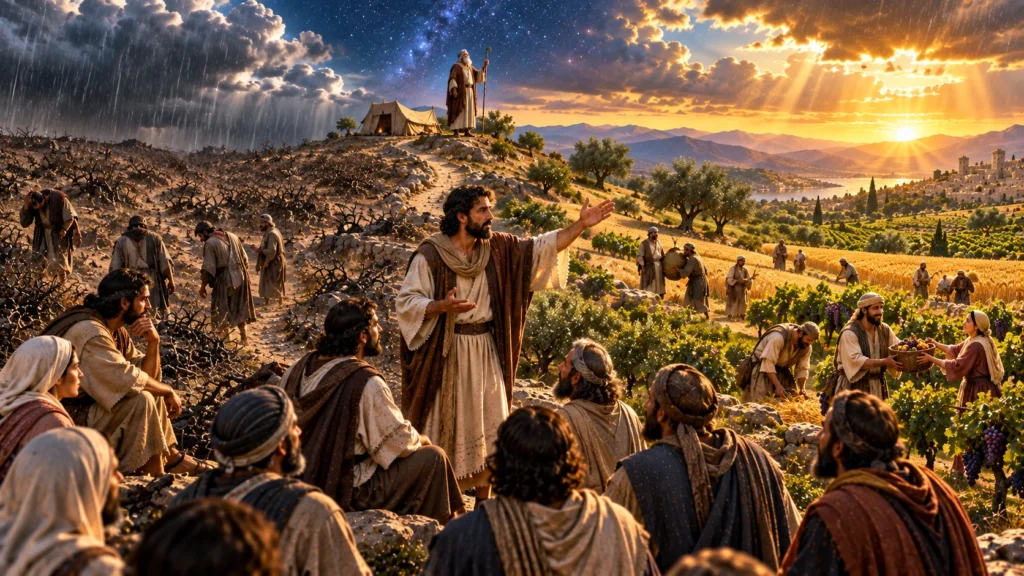
The writer illustrates the warning using farmland.
He describes earth that repeatedly receives rain.
When that land produces useful vegetation:
“It receiveth blessing from God.”
But land receiving the same rain and producing:
“Thorns and briers”
reveals something very different.
It is:
“Rejected, and is nigh unto cursing.”
The picture emphasizes that receiving spiritual privileges should eventually produce spiritual fruit.
The same rain falls upon both kinds of soil.
The harvest reveals what the ground produces.
Yet after this severe warning, the tone changes dramatically.
The writer says:
“But, beloved, we are persuaded better things of you.”
He does not assume that his readers are doomed.
Instead, he expresses confidence concerning:
“Things that accompany salvation.”
The warning is serious, but so is the encouragement.
The writer then reminds them of God’s character:
“For God is not unrighteous to forget your work and labour of love.”
God has seen their faithful service.
He remembers how they have ministered:
“To the saints.”
And how they continue serving.
Human beings may overlook acts of faithful Christian love.
God does not.
The writer wants every believer to demonstrate:
“The same diligence to the full assurance of hope unto the end.”
Perseverance matters.
They must not become:
“Slothful.”
Instead, they should become:
“Followers of them who through faith and patience inherit the promises.”
Faith and patience belong together.
Trusting God often involves waiting for what He has promised.
The writer then presents Abraham as a major example.
God made a promise to Abraham.
Because there was no one greater by whom God could swear:
“He sware by himself.”
God promised:
“Surely blessing I will bless thee, and multiplying I will multiply thee.”
Abraham did not receive everything immediately.
Hebrews says:
“After he had patiently endured, he obtained the promise.”
This becomes a powerful model for believers.
God’s promises may require patient endurance.
Delay does not mean that God has forgotten.
The writer then explains the significance of an oath.
Human beings commonly swear by someone greater than themselves to confirm a matter.
God, desiring to show:
“The immutability of his counsel,”
confirmed His promise with an oath.
The result is:
“Two immutable things, in which it was impossible for God to lie.”
God’s promise and oath reveal the absolute reliability of His purpose.
Therefore, believers who have:
“Fled for refuge”
can possess:
“Strong consolation.”
They are called to:
“Lay hold upon the hope set before us.”
The imagery suggests people fleeing from danger toward a place of safety and then grasping firmly onto the hope God provides.
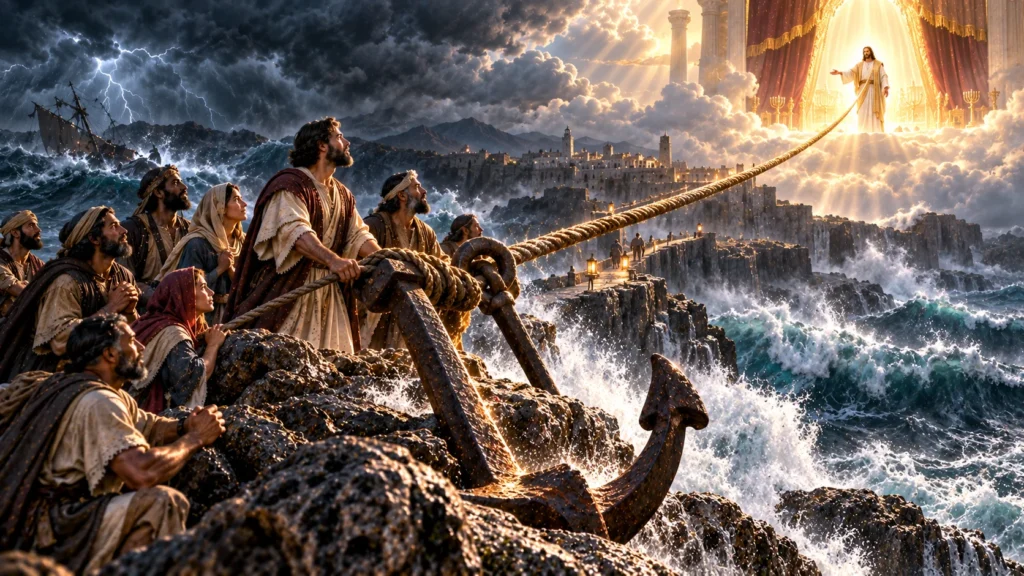
The writer then gives one of the most memorable pictures in the entire book of Hebrews:
“Which hope we have as an anchor of the soul, both sure and stedfast.”
Hope in God is like an anchor.
But unlike a ship’s anchor descending into the unseen depths beneath the water, this spiritual anchor reaches upward:
“Into that within the veil.”
The imagery points toward the Most Holy Place, the place associated with God’s presence.
Under the old covenant, the high priest entered behind the veil.
But believers now possess a hope reaching into God’s presence because Jesus has already entered there.
The writer calls Jesus:
“The forerunner.”
A forerunner goes ahead of others.
Jesus has entered God’s presence on behalf of His people and opened the way before them.
The chapter concludes:
“Even Jesus, made an high priest for ever after the order of Melchisedec.”
This prepares directly for Hebrews Chapter 7.
Jesus is not a temporary priest.
His priesthood is eternal.
Therefore, Christian hope is secure not because believers possess perfect circumstances or human strength.
Their hope is anchored in God’s unchangeable promise and Jesus Christ’s eternal priesthood.
Hebrews Chapter 6 therefore presents a powerful progression:
leave spiritual infancy → pursue maturity → take apostasy seriously → produce spiritual fruit → remember that God sees faithful service → remain diligent → imitate faith and patience → remember Abraham → trust God’s unchangeable promise → lay hold of hope → anchor the soul in God’s presence → trust Jesus, the eternal High Priest.
The chapter contains both warning and assurance.
It warns believers not to drift backward.
But it also gives them an extraordinary reason to move forward:
God cannot lie, His promise does not change, and Jesus has already entered God’s presence as the eternal High Priest for His people.
Key Lessons – Hebrews Chapter 6
- Christians should continue growing toward spiritual maturity. Foundational truths are essential, but believers should build upon them rather than remain spiritually immature.
- Spiritual privilege brings serious responsibility. Experiencing the blessings surrounding the Christian faith should never lead to complacency about Christ.
- Turning away from Christ is treated as an extremely serious matter. Hebrews gives a strong warning against rejecting the One through whom salvation comes.
- Spiritual fruit matters. The illustration of rain falling upon farmland shows that what a person continually produces reveals the condition of the soil.
- Warning and encouragement belong together. Immediately after the severe warning, the writer tells his readers that he is persuaded of “better things” concerning them.
- God does not forget faithful service. Acts of love performed for His people may go unnoticed by others, but God sees them.
- Believers should remain diligent until the end. Christian perseverance involves continuing in faith, hope, love, and obedience rather than becoming spiritually lazy.
- Faith requires patience. Abraham received God’s promise after patiently enduring.
- God’s promises are completely trustworthy. His character does not change, and it is impossible for God to lie.
- Christian hope provides stability during uncertainty. Hebrews describes hope as “an anchor of the soul.”
- Our spiritual anchor reaches into God’s presence. Christian assurance rests beyond changing earthly circumstances.
- Jesus has gone before His people. He is the forerunner who has entered within the veil on their behalf.
- Jesus is the eternal High Priest. His priesthood after the order of Melchisedec provides a permanent foundation for Christian hope.
Important Verses
- Hebrews 6:1
- “Therefore leaving the principles of the doctrine of Christ, let us go on unto perfection.”
- Hebrews 6:7
- “For the earth which drinketh in the rain that cometh oft upon it… receiveth blessing from God.”
- Hebrews 6:9
- “But, beloved, we are persuaded better things of you, and things that accompany salvation.”
- Hebrews 6:10
- “For God is not unrighteous to forget your work and labour of love.”
- Hebrews 6:11
- “We desire that every one of you do shew the same diligence to the full assurance of hope unto the end.”
- Hebrews 6:12
- “Be followers of them who through faith and patience inherit the promises.”
- Hebrews 6:15
- “And so, after he had patiently endured, he obtained the promise.”
- Hebrews 6:18
- “It was impossible for God to lie.”
- Hebrews 6:19
- “Which hope we have as an anchor of the soul, both sure and stedfast.”
- Hebrews 6:20
- “Whither the forerunner is for us entered, even Jesus, made an high priest for ever after the order of Melchisedec.”