
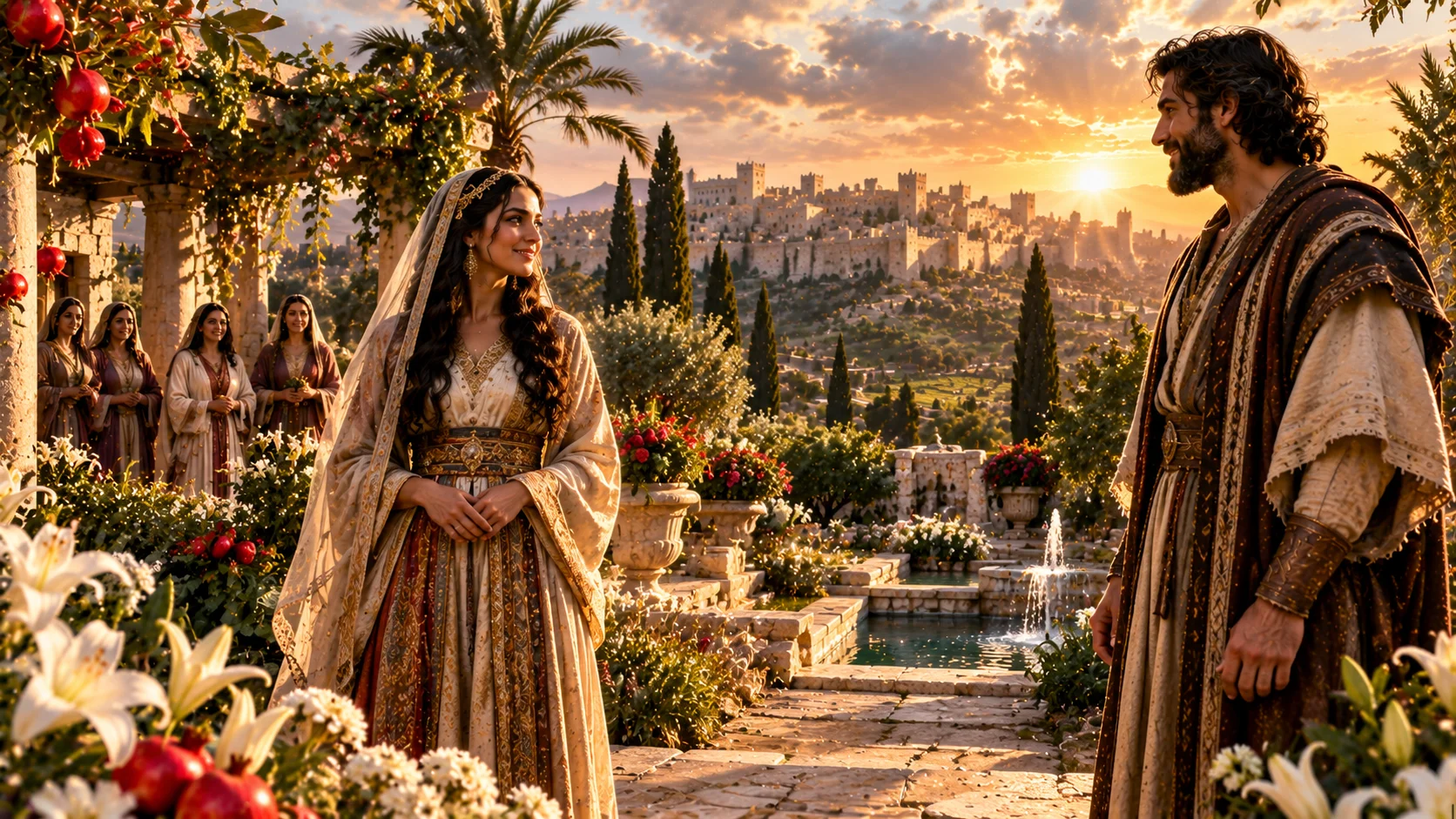
Song of Solomon Chapter 6 continues the poetic celebration of love between the bride and her beloved. After the longing and separation expressed in the previous chapter, the bride confidently declares where her beloved has gone and affirms that they still belong to one another. The beloved then praises her beauty with vivid images drawn from ancient Israel, describing her as beautiful, unique, and overwhelming in her loveliness. The chapter emphasizes restored closeness, mutual devotion, admiration, exclusivity, and the powerful bond of committed love. Its poetic imagery portrays a relationship in which both beloved and bride value one another deeply.
Song of Solomon Chapter 6 Summary
Song of Solomon 6 begins with the daughters of Jerusalem asking the bride where her beloved has gone.
They have heard her passionate description of him and now offer to help her search.
The bride answers confidently.
Her beloved has gone down to his garden, among the beds of spices, to feed among the gardens and gather lilies.
She then makes one of the chapter’s most important declarations:
“I am my beloved’s, and my beloved is mine.”
Despite the separation and difficulty described previously, the relationship remains secure.
The beloved then speaks and praises the bride.
He compares her beauty to Tirzah and Jerusalem, two cities associated with beauty and splendor.
Yet her beauty is not described merely as gentle.
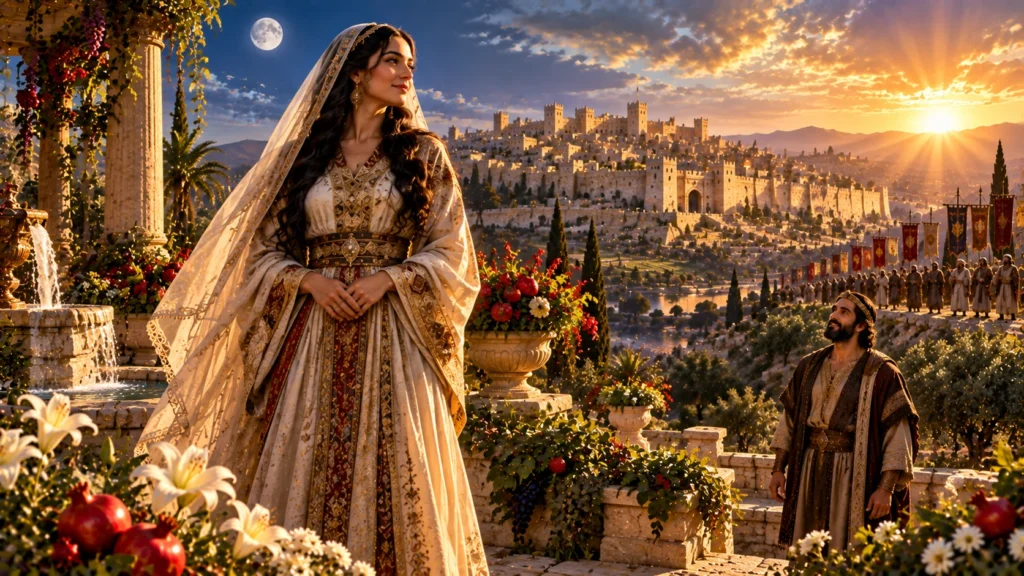
He says she is “terrible as an army with banners,” portraying her presence as powerful, majestic, and overwhelming.
He asks her to turn her eyes away because their beauty overwhelms him.
The beloved continues describing her using the rich poetic imagery characteristic of Song of Solomon.
Her hair is compared to a flock of goats descending from Gilead.
Her teeth are compared to a flock of sheep coming from washing, emphasizing order, beauty, and completeness.
Her temples are compared to pieces of pomegranate behind her veil.
The beloved then contrasts her with the many queens, concubines, and young women of the royal court.
Yet among them all, the bride is described as unique.
She is called his dove and his undefiled one.
She is the only one of her mother and especially precious to the woman who gave birth to her.
Other women see her and call her blessed.
Queens and concubines also praise her.
The beloved then describes her appearance with another magnificent poetic picture:
“Who is she that looketh forth as the morning, fair as the moon, clear as the sun, and terrible as an army with banners?”
The imagery presents the bride as radiant, beautiful, majestic, and unforgettable.
The scene then shifts.
The speaker goes down to the garden of nuts to examine the plants of the valley and see whether the vines have budded and the pomegranates are blooming.
The garden imagery again connects love with growth, beauty, fruitfulness, and renewal.
The speaker then describes a sudden emotional movement that is difficult to interpret precisely because of the highly poetic Hebrew language.
The chapter concludes with a call for the Shulamite to return so that she may be seen again.
The response asks why they desire to gaze upon the Shulamite.
The final phrase refers to something like the dance or gathering of Mahanaim, creating a dramatic ending filled with movement, admiration, and celebration.
Throughout the chapter, the central relationship has moved from uncertainty toward renewed confidence.
The bride knows whom she loves.
The beloved knows whom he desires.
Their mutual devotion remains at the center:
“I am my beloved’s, and my beloved is mine.”
Key Lessons – Song of Solomon Chapter 6
- Committed love provides security. The bride confidently declares that she and her beloved belong to one another.
- Healthy love expresses appreciation. The beloved openly communicates what he values and admires about the bride.
- Love sees the beloved as unique. Although many others surround him, the beloved describes his bride as incomparable.
- Reconciliation can follow seasons of distance. The tension and searching of the previous chapter give way to renewed assurance and admiration.
- Love involves mutual belonging rather than one-sided desire. Both partners are presented as deeply connected to one another.
- Words have power within relationships. The chapter is filled with affirming language that communicates admiration, value, beauty, and devotion.
- Faithful love values the whole person. The beloved’s poetic praise communicates more than physical attraction—it presents the bride as precious, distinguished, and irreplaceable.
Important Verses
- Song of Solomon 6:2
- “My beloved is gone down into his garden, to the beds of spices, to feed in the gardens, and to gather lilies.”
- Song of Solomon 6:3
- “I am my beloved’s, and my beloved is mine: he feedeth among the lilies.”
- Song of Solomon 6:4
- “Thou art beautiful, O my love, as Tirzah, comely as Jerusalem, terrible as an army with banners.”
- Song of Solomon 6:5
- “Turn away thine eyes from me, for they have overcome me.”
- Song of Solomon 6:9
- “My dove, my undefiled is but one; she is the only one of her mother.”
- Song of Solomon 6:10
- “Who is she that looketh forth as the morning, fair as the moon, clear as the sun, and terrible as an army with banners?”