

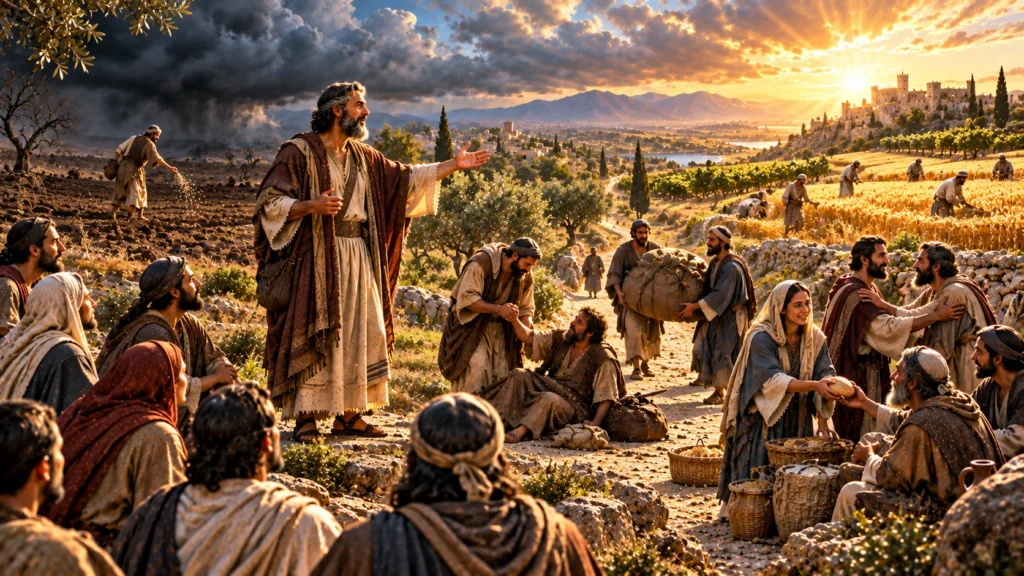


Ephesians Chapter 6 concludes Paul’s letter with practical instructions for Christian relationships and one of Scripture’s most memorable descriptions of spiritual warfare: the whole armor of God. Paul addresses relationships within first-century households, calling family members and those in positions of authority to act according to Christ rather than selfishness or abuse. He then reveals that the Christian struggle ultimately extends beyond human opposition to spiritual forces of evil. Believers therefore need God’s strength and His armor: truth, righteousness, the preparation of the gospel of peace, faith, salvation, the Word of God, and continual prayer. Paul’s message is not to live in fear of spiritual opposition but to “be strong in the Lord, and in the power of his might,” standing faithfully through everything that comes against them.
Ephesians Chapter 6 Summary
Ephesians Chapter 6 begins with Paul continuing his instructions concerning Christian households.
He addresses obedience within the family and writes:
“Children, obey your parents in the Lord: for this is right.”
He then points back to the commandment:
“Honour thy father and mother.”
Paul notes that this commandment includes a promise:
“That it may be well with thee, and thou mayest live long on the earth.”
Paul then addresses fathers.
He warns:
“Provoke not your children to wrath.”
Parental authority should not be harsh, selfish, humiliating, or deliberately provoking.
Instead, parents should nurture those entrusted to them:
“In the nurture and admonition of the Lord.”
Paul then addresses another major feature of the first-century Roman world: the relationship between enslaved people and earthly masters.
He instructs Christian servants to work sincerely:
“As unto Christ.”
Their service should not be merely:
“With eyeservice, as menpleasers.”
In other words, they should not work faithfully only when someone is watching.
Instead, Paul calls for integrity:
“Doing the will of God from the heart.”
He continues:
“With good will doing service, as to the Lord, and not to men.”
Paul reminds them that God sees faithful service even when human beings fail to recognize it.
Whatever good someone does, the Lord sees and will ultimately reward.
Paul then turns directly toward masters.
His instructions place moral responsibility upon those possessing social authority.
He commands them to treat those under them properly and to stop threatening them.
Why?
Because earthly masters themselves have a Master in heaven.
Paul writes:
“Knowing that your Master also is in heaven.”
Before God, earthly status does not create spiritual superiority.
Paul adds:
“Neither is there respect of persons with him.”
God is not impressed by human rank.
Master and servant alike stand accountable before Him.
Paul then transitions into the famous conclusion of Ephesians.
He writes:
“Finally, my brethren, be strong in the Lord, and in the power of his might.”
The Christian life requires strength.
But Paul does not tell believers merely to become mentally tougher or depend upon their own willpower.
Their strength must come:
“In the Lord.”
He commands:
“Put on the whole armour of God.”
Why?
“That ye may be able to stand against the wiles of the devil.”
Paul portrays the Christian life as involving genuine spiritual conflict.
The enemy uses schemes, deception, temptation, accusation, division, and other forms of opposition.
Yet Paul immediately clarifies the true nature of the struggle:
“For we wrestle not against flesh and blood.”
Human beings are not ultimately the enemy.
The struggle extends beyond what can be physically seen.
Paul describes:
“Principalities.”
“Powers.”
“The rulers of the darkness of this world.”
And:
“Spiritual wickedness in high places.”
Because the battle is spiritual, merely human resources are insufficient.
Paul therefore repeats:
“Take unto you the whole armour of God.”
The purpose is:
“That ye may be able to withstand in the evil day.”
And after everything:
“To stand.”
That word becomes one of the dominant themes of the passage.
Paul does not picture believers desperately attempting to create their own victory.
They are equipped by God to stand faithfully.
He begins describing the armor.
First:
“Stand therefore, having your loins girt about with truth.”
Truth surrounds and stabilizes the believer.
The Christian must reject deception and live according to what God has revealed.
Next comes:
“The breastplate of righteousness.”
A soldier’s breastplate protects vital areas.
Righteousness represents the godly life that should characterize those who belong to Christ, grounded in their relationship with Him.
Paul then turns toward the feet:
“Your feet shod with the preparation of the gospel of peace.”
The believer stands ready upon the good news of peace through Jesus Christ and remains prepared to carry that message.
Then Paul emphasizes:
“Above all, taking the shield of faith.”
The shield has an important purpose.
With it believers:
“Shall be able to quench all the fiery darts of the wicked.”
The enemy’s attacks may come suddenly and repeatedly.
Faith responds by trusting God’s character, promises, power, and faithfulness.
Paul then commands believers to take:
“The helmet of salvation.”
The assurance and hope connected with God’s salvation guard the believer.
Then comes the only explicitly offensive weapon in the armor:
“The sword of the Spirit, which is the word of God.”
God’s Word exposes lies and gives believers truth with which to resist deception and temptation.
But Paul does not finish with the sword.
The entire armor is surrounded by prayer.
He writes:
“Praying always with all prayer and supplication in the Spirit.”
Prayer is not merely another item attached to the end of the armor.
It is the continuing dependence upon God that accompanies the entire spiritual battle.
Believers should remain:
“Watching thereunto with all perseverance.”
Spiritual vigilance requires persistence.
Paul also asks the Ephesians to pray specifically for him.
His request is revealing.
Paul is imprisoned, yet he does not primarily ask that his circumstances become easier.
He asks that:
“Utterance may be given unto me.”
He wants to speak:
“Boldly, to make known the mystery of the gospel.”
Paul calls himself:
“An ambassador in bonds.”
The Roman government may physically restrain him, but Paul still understands himself as an ambassador representing Christ.
He asks for prayer that he may speak the gospel:
“Boldly, as I ought to speak.”
Paul then mentions Tychicus, whom he describes as:
“A beloved brother and faithful minister in the Lord.”
Tychicus will inform the Ephesians about Paul’s circumstances and encourage their hearts.
Paul concludes the letter with a blessing.
He wishes them:
“Peace.”
“Love with faith.”
And finally:
“Grace be with all them that love our Lord Jesus Christ in sincerity.”
Ephesians Chapter 6 therefore presents a powerful progression:
faithfulness in relationships → accountability before God → strength in the Lord → recognize the spiritual battle → put on the whole armor of God → stand in truth and righteousness → carry the gospel of peace → raise the shield of faith → receive the helmet of salvation → use the Word of God → pray continually → proclaim the gospel boldly → finish in peace, love, faith, and grace.
Paul’s final picture is not of frightened Christians hiding from evil.
It is of believers standing.
They stand not because they are naturally powerful.
They stand because God provides the strength and the armor.
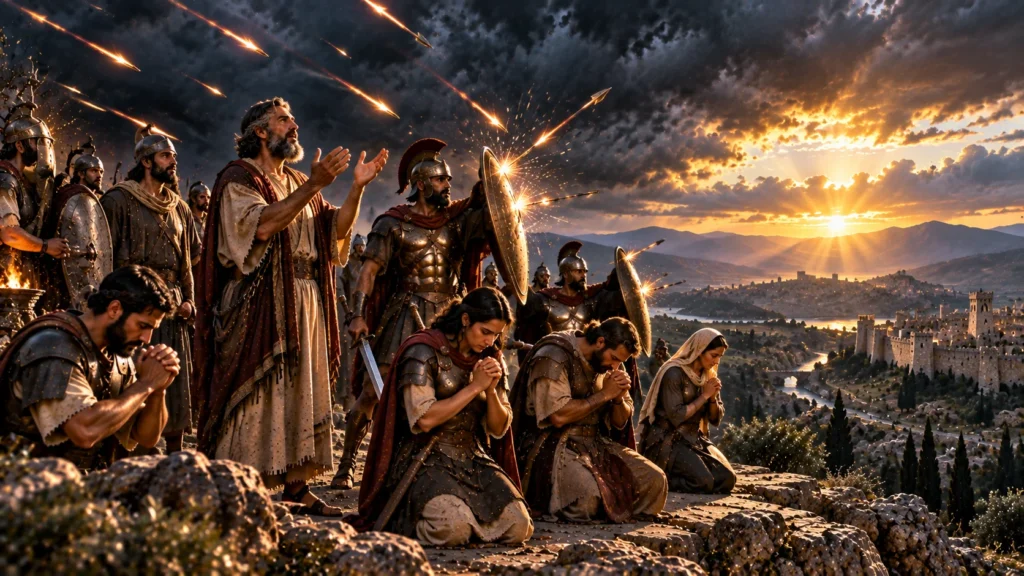
Key Lessons – Ephesians Chapter 6
- Christian faith should shape everyday relationships. Paul applies devotion to Christ to family life, work, leadership, and authority.
- Authority must never become an excuse for cruelty. Those with responsibility over others remain accountable to the Master in heaven.
- God does not judge people according to worldly status. Paul reminds both servants and masters that there is no partiality with God.
- Spiritual strength comes from God rather than human willpower. Believers are commanded to be strong “in the Lord, and in the power of his might.”
- Christians face genuine spiritual opposition. Paul warns about the schemes of the devil and spiritual forces of evil.
- People themselves are not ultimately the enemy. Paul says, “We wrestle not against flesh and blood.”
- Believers need the whole armor of God. No single piece represents everything needed for spiritual endurance.
- Truth protects against deception. The belt of truth represents a life anchored in what God has revealed.
- Righteousness is essential to spiritual readiness. The breastplate represents a life aligned with God’s ways.
- Christians should remain ready with the gospel of peace. The believer’s feet are prepared to stand and carry the good news of Christ.
- Faith extinguishes the enemy’s fiery attacks. Trust in God acts as a shield against spiritual assault.
- Salvation protects the believer’s hope and identity. Paul describes salvation as a helmet.
- God’s Word is the sword of the Spirit. Scripture provides truth for resisting lies, temptation, and spiritual deception.
- Prayer surrounds the entire spiritual battle. Paul commands continual prayer, vigilance, perseverance, and intercession for other believers.
- Bold gospel witness remains important even during hardship. Paul asks for prayer not merely for release from imprisonment but for courage to proclaim Christ.
- The goal is to stand faithfully. Paul repeatedly emphasizes remaining firm through spiritual opposition by depending upon God.
Important Verses
- Ephesians 6:7
- “With good will doing service, as to the Lord, and not to men.”
- Ephesians 6:9
- “Knowing that your Master also is in heaven; neither is there respect of persons with him.”
- Ephesians 6:10
- “Finally, my brethren, be strong in the Lord, and in the power of his might.”
- Ephesians 6:11
- “Put on the whole armour of God, that ye may be able to stand against the wiles of the devil.”
- Ephesians 6:12
- “For we wrestle not against flesh and blood, but against principalities, against powers.”
- Ephesians 6:13
- “Take unto you the whole armour of God, that ye may be able to withstand in the evil day.”
- Ephesians 6:14
- “Stand therefore, having your loins girt about with truth, and having on the breastplate of righteousness.”
- Ephesians 6:15
- “And your feet shod with the preparation of the gospel of peace.”
- Ephesians 6:16
- “Above all, taking the shield of faith, wherewith ye shall be able to quench all the fiery darts of the wicked.”
- Ephesians 6:17
- “And take the helmet of salvation, and the sword of the Spirit, which is the word of God.”
- Ephesians 6:18
- “Praying always with all prayer and supplication in the Spirit.”
- Ephesians 6:19
- “That I may open my mouth boldly, to make known the mystery of the gospel.”