


Revelation Chapter 6 marks a dramatic turning point in John’s vision as Jesus Christ, the Lamb, begins opening the seals of the scroll introduced in Revelation Chapter 5. As the first six seals are opened, John witnesses conquest, warfare, scarcity, death, persecution, cosmic upheaval, and humanity’s terror before divine judgment. The famous Four Horsemen of the Apocalypse appear under the first four seals. The fifth seal reveals faithful martyrs beneath the altar crying out for justice, while the sixth seal brings a terrifying shaking of creation as people from every level of society attempt to hide. The chapter ends with the solemn question: “For the great day of his wrath is come; and who shall be able to stand?” Yet throughout the vision, events unfold only as the Lamb opens each seal, emphasizing that history and judgment ultimately remain under divine authority.
Revelation Chapter 6 Summary
Revelation Chapter 6 continues directly from the heavenly throne-room vision of Revelation Chapters 4 and 5.
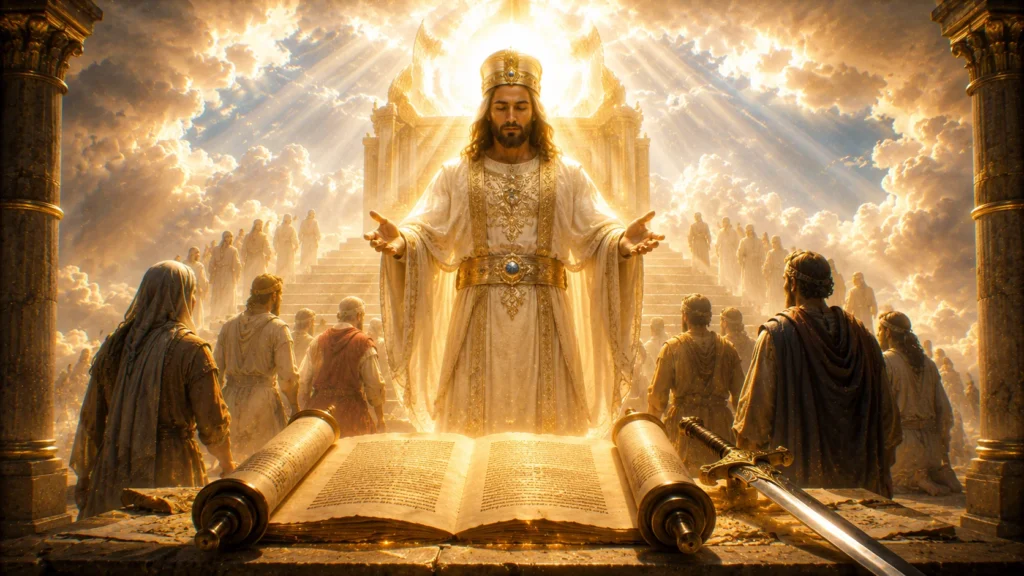
John has seen a scroll sealed with seven seals.
No one in heaven, earth, or under the earth was worthy to open it until Jesus Christ appeared as the victorious Lamb.
Now the Lamb begins opening the seals.
John writes:
“And I saw when the Lamb opened one of the seals.”
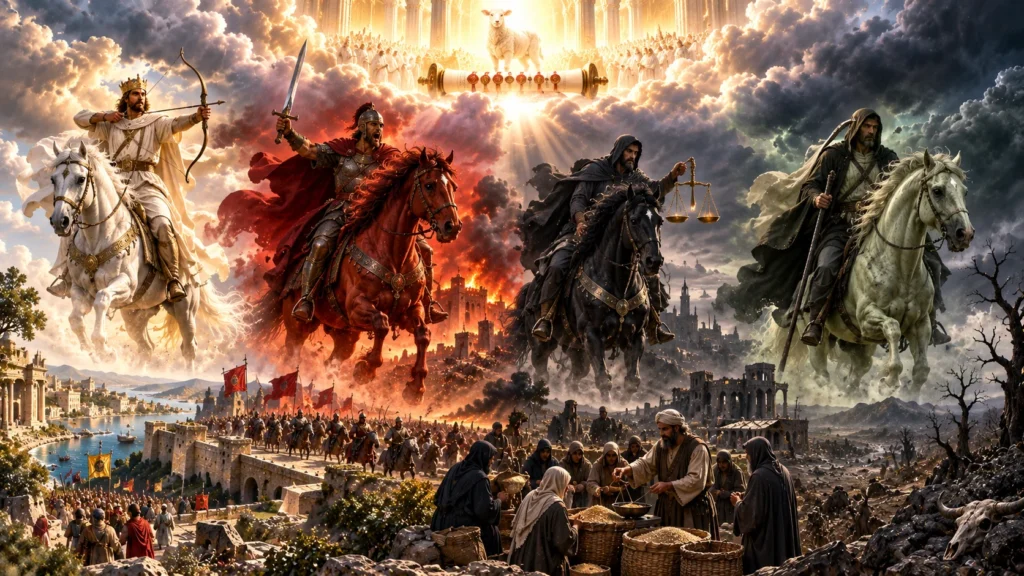
When the first seal is opened, one of the four living creatures calls:
“Come and see.”
John looks and sees:
“A white horse.”
Its rider possesses a bow.
A crown is given to him.
Then:
“He went forth conquering, and to conquer.”
This is the first horseman.
The precise identity of this rider has been interpreted differently.
Many interpreters understand him as representing conquest, imperial expansion, or deceptive worldly domination. Some interpreters have understood the rider differently, including as a symbol connected with victorious proclamation.
Within the sequence of Revelation 6, however, the first rider is followed by warfare, scarcity, and death, forming a terrifying progression of earthly calamity.
The Lamb then opens the second seal.
Another horse appears.
This one is:
“Red.”
Its rider receives power:
“To take peace from the earth.”
The result is widespread human conflict:
“That they should kill one another.”
The rider is also given:
“A great sword.”
The second horseman therefore represents warfare and the removal of peace.
The vision moves from conquest toward violent conflict.
Then the Lamb opens the third seal.
John sees:
“A black horse.”
The rider carries:
“A pair of balances in his hand.”
John hears a voice describing extremely costly basic food:
“A measure of wheat for a penny, and three measures of barley for a penny.”
The imagery suggests severe economic hardship and food scarcity.
The scales portray food being carefully measured.
Ordinary necessities have become painfully expensive.
Yet the voice adds:
“See thou hurt not the oil and the wine.”
The precise economic implications have been interpreted in different ways, but the overall picture is one of scarcity, imbalance, and hardship.
Then comes the fourth seal.
John sees:
“A pale horse.”
The Greek term translated “pale” describes a sickly greenish or pale color.
Unlike the earlier riders, this horseman is explicitly named:
“His name that sat on him was Death.”
And:
“Hell followed with him.”
Authority is given over:
“The fourth part of the earth.”
Death comes through several forms of devastation:
“Sword.”
“Hunger.”
“Death.”
And:
“The beasts of the earth.”
The first four seals therefore create one of the most memorable sequences in biblical prophecy:
white horse → conquest
red horse → warfare
black horse → scarcity
pale horse → death
Together they are commonly known as the Four Horsemen of the Apocalypse.
Yet an important detail runs throughout the passage.
The horsemen do not seize ultimate authority for themselves.
The Lamb opens the seals, and authority is given.
The vision therefore does not portray history as completely uncontrolled chaos.
Even terrifying events remain within boundaries established by divine sovereignty.
The Lamb then opens the fifth seal.
The scene changes dramatically.
Instead of another horseman, John sees:
“Under the altar the souls of them that were slain for the word of God, and for the testimony which they held.”
These are faithful witnesses who suffered death because of their devotion to God.
They cry:
“How long, O Lord, holy and true, dost thou not judge and avenge our blood on them that dwell on the earth?”
Their cry is a plea for divine justice.
They are not forgotten.
Their suffering has been seen.
Their faithfulness matters before God.
John says:
“White robes were given unto every one of them.”
They are told to:
“Rest yet for a little season.”
The final resolution has not yet arrived.
Others will also suffer for their faithful testimony before the appointed course is completed.
The fifth seal therefore introduces another major theme of Revelation:
faithful endurance under persecution.
The world may treat faithful witnesses as defeated.
Heaven sees them differently.
They are remembered.
They receive white robes.
Their cries are heard.
And justice will not be forgotten.
Then the Lamb opens the sixth seal.
The vision expands to a cosmic scale.
John says:
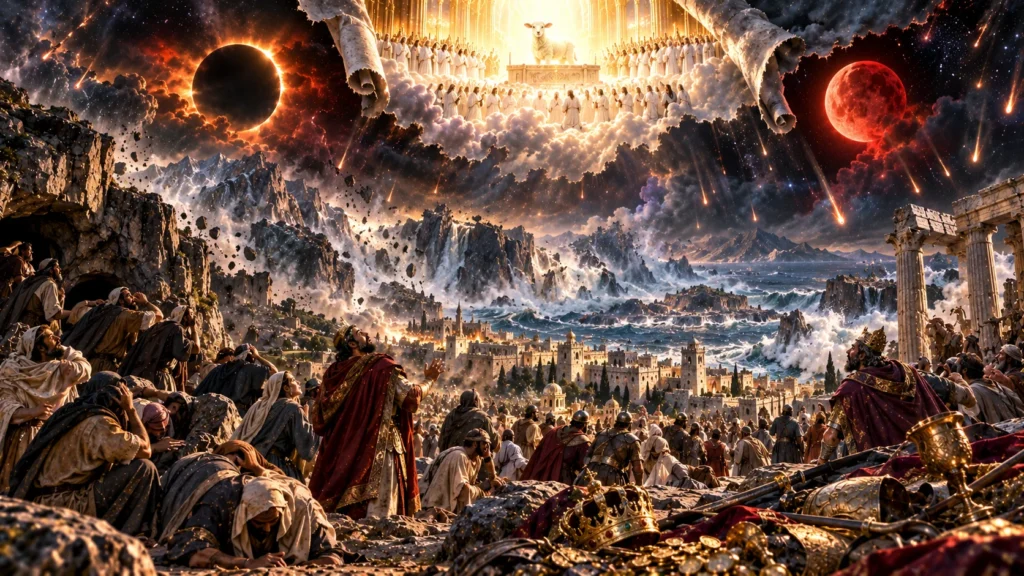
“There was a great earthquake.”
Then:
“The sun became black as sackcloth of hair.”
The moon becomes:
“As blood.”
John sees:
“The stars of heaven fell unto the earth.”
He compares them to unripe figs shaken from a tree by a powerful wind.
Then:
“The heaven departed as a scroll when it is rolled together.”
And:
“Every mountain and island were moved out of their places.”
The imagery communicates overwhelming cosmic upheaval.
Everything people normally regard as stable appears shaken.
The response of humanity is universal.
John lists:
“The kings of the earth.”
“The great men.”
“The rich men.”
“The chief captains.”
“The mighty men.”
“Every bondman.”
And:
“Every free man.”
Social position provides no protection.
Political authority provides no protection.
Military strength provides no protection.
Wealth provides no protection.
People hide:
“In the dens and in the rocks of the mountains.”
They cry to the mountains and rocks:
“Fall on us, and hide us from the face of him that sitteth on the throne, and from the wrath of the Lamb.”
The expression “wrath of the Lamb” creates a striking contrast.
A lamb normally suggests gentleness and vulnerability.
But this Lamb is the crucified and victorious Jesus Christ who possesses authority to open the seals.
The One who offered salvation is also associated here with divine judgment.
The chapter concludes:
“For the great day of his wrath is come.”
Then comes the question:
“And who shall be able to stand?”
Revelation Chapter 6 intentionally leaves that question hanging.
Chapter 7 will interrupt the seal sequence before the seventh seal and provide an important vision concerning God’s servants and the great multitude before His throne.
Revelation Chapter 6 therefore presents a dramatic progression:
the Lamb opens the scroll → conquest advances → peace disappears → scarcity spreads → death follows → faithful martyrs cry for justice → creation itself is shaken → human power proves helpless → the day of judgment arrives → “Who shall be able to stand?”
The chapter is frightening, but its central figure is not one of the horsemen.
It is the Lamb.
The horsemen appear only as the Lamb opens the seals.
The martyrs are remembered.
Human empires are shown to be temporary.
And history continues moving toward the judgment and ultimate purposes of God.
Key Lessons – Revelation Chapter 6
- Jesus Christ remains central even during judgment. The Lamb is the One opening the seals and moving the vision forward.
- Human conquest does not provide lasting peace. The first seals show conquest followed by warfare, scarcity, and death.
- War produces consequences far beyond the battlefield. The progression of the horsemen connects conflict with social disruption, scarcity, suffering, and death.
- Material security is fragile. The black horse portrays a world in which basic necessities become painfully costly.
- Death is powerful but not ultimately sovereign. Even the pale horse operates only within authority that is given.
- God does not forget faithful believers who suffer. The martyrs beneath the altar are seen, heard, and given white robes.
- Long periods of waiting do not mean that God has forgotten justice. The martyrs are told to rest for a little season.
- Faithfulness to God may involve costly endurance. Revelation honors those who maintain their testimony even under persecution.
- Earthly status cannot protect anyone from ultimate accountability. Kings, wealthy people, military leaders, servants, and free people all face the same reality under the sixth seal.
- Creation itself is portrayed as shaken before divine judgment. The earthquake and cosmic signs emphasize the overwhelming magnitude of the vision.
- The Lamb is both Savior and Judge. Revelation presents Jesus as the sacrificed Lamb while also associating Him with final judgment.
- The chapter challenges every reader with its final question.“Who shall be able to stand?” prepares for the visions that follow.
Important Verses
- Revelation 6:1
- “And I saw when the Lamb opened one of the seals.”
- Revelation 6:2
- “And behold a white horse: and he that sat on him had a bow; and a crown was given unto him.”
- Revelation 6:4
- “And there went out another horse that was red: and power was given to him that sat thereon to take peace from the earth.”
- Revelation 6:5
- “And I beheld, and lo a black horse; and he that sat on him had a pair of balances in his hand.”
- Revelation 6:8
- “And I looked, and behold a pale horse: and his name that sat on him was Death.”
- Revelation 6:9
- “I saw under the altar the souls of them that were slain for the word of God, and for the testimony which they held.”
- Revelation 6:10
- “How long, O Lord, holy and true, dost thou not judge and avenge our blood?”
- Revelation 6:11
- “And white robes were given unto every one of them.”
- Revelation 6:12
- “And, lo, there was a great earthquake; and the sun became black as sackcloth of hair.”
- Revelation 6:14
- “And the heaven departed as a scroll when it is rolled together; and every mountain and island were moved out of their places.”
- Revelation 6:16
- “Hide us from the face of him that sitteth on the throne, and from the wrath of the Lamb.”
- Revelation 6:17
- “For the great day of his wrath is come; and who shall be able to stand?”