


Genesis Chapter 9 begins a new era after the Flood. Noah, his family, and the animals have left the ark, and God now establishes the conditions under which humanity will continue upon the renewed earth.
God blesses Noah and his sons and commands them to “be fruitful, and multiply, and replenish the earth.” Humanity is given permission to eat animals for food, while God also establishes important commands concerning blood and the sacredness of human life.
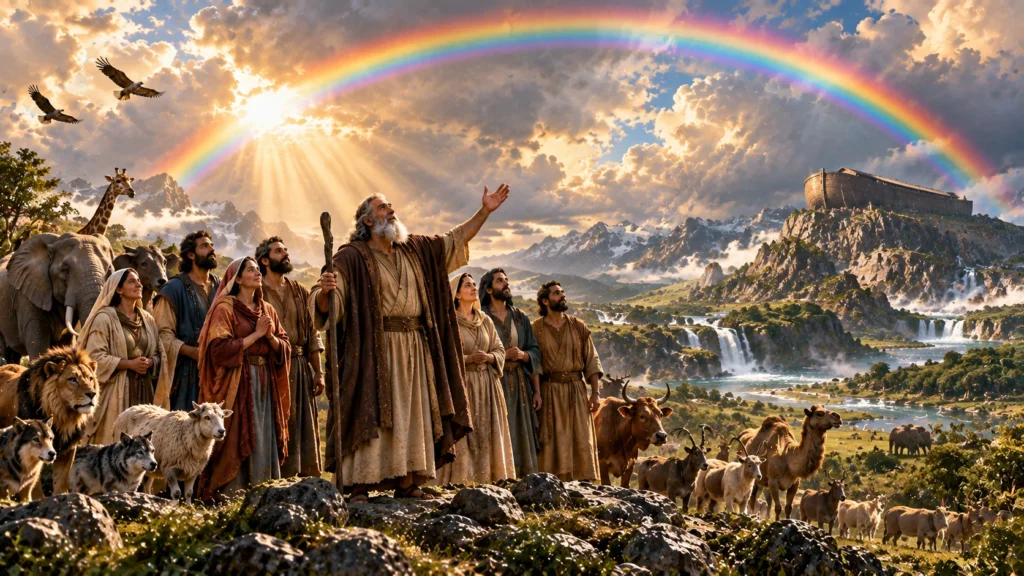
The central event of the chapter is God’s covenant with Noah, his descendants, and every living creature. God promises never again to destroy all flesh with a flood and establishes the rainbow as the sign of the covenant.
The chapter concludes with an account involving Noah and his sons that shapes the future relationships among their descendants.
Genesis Chapter 9 Summary
After Noah and his family leave the ark, God blesses Noah and his sons, Shem, Ham, and Japheth. He commands them to be fruitful, multiply, and fill the earth.
God establishes a changed relationship between humanity and the animal world. Animals will now experience fear and dread toward humans, and humanity is permitted to eat living creatures for food just as God had previously provided plants.
However, God gives an important restriction: they must not eat flesh with its lifeblood still in it.
God then emphasizes the sacred value of human life. Human bloodshed is treated with particular seriousness because humanity was made in the image of God. This principle establishes a strong distinction between human life and the lives of animals.
God again tells Noah and his sons to be fruitful, multiply, and spread throughout the earth.
God then establishes a covenant not only with Noah and his sons but also with their descendants and every living creature that came out of the ark. Birds, livestock, and wild animals are included within the scope of this covenant.
God promises that never again will all flesh be destroyed by the waters of a flood, and never again will a flood destroy the earth in the manner Noah’s generation experienced.
As the visible sign of this covenant, God places His bow in the clouds. Whenever the bow appears, it serves as the sign of the covenant between God, humanity, and every living creature upon the earth.
The chapter then turns to Noah’s family. Noah’s three sons—Shem, Ham, and Japheth—become the ancestors through whom the earth will be repopulated.
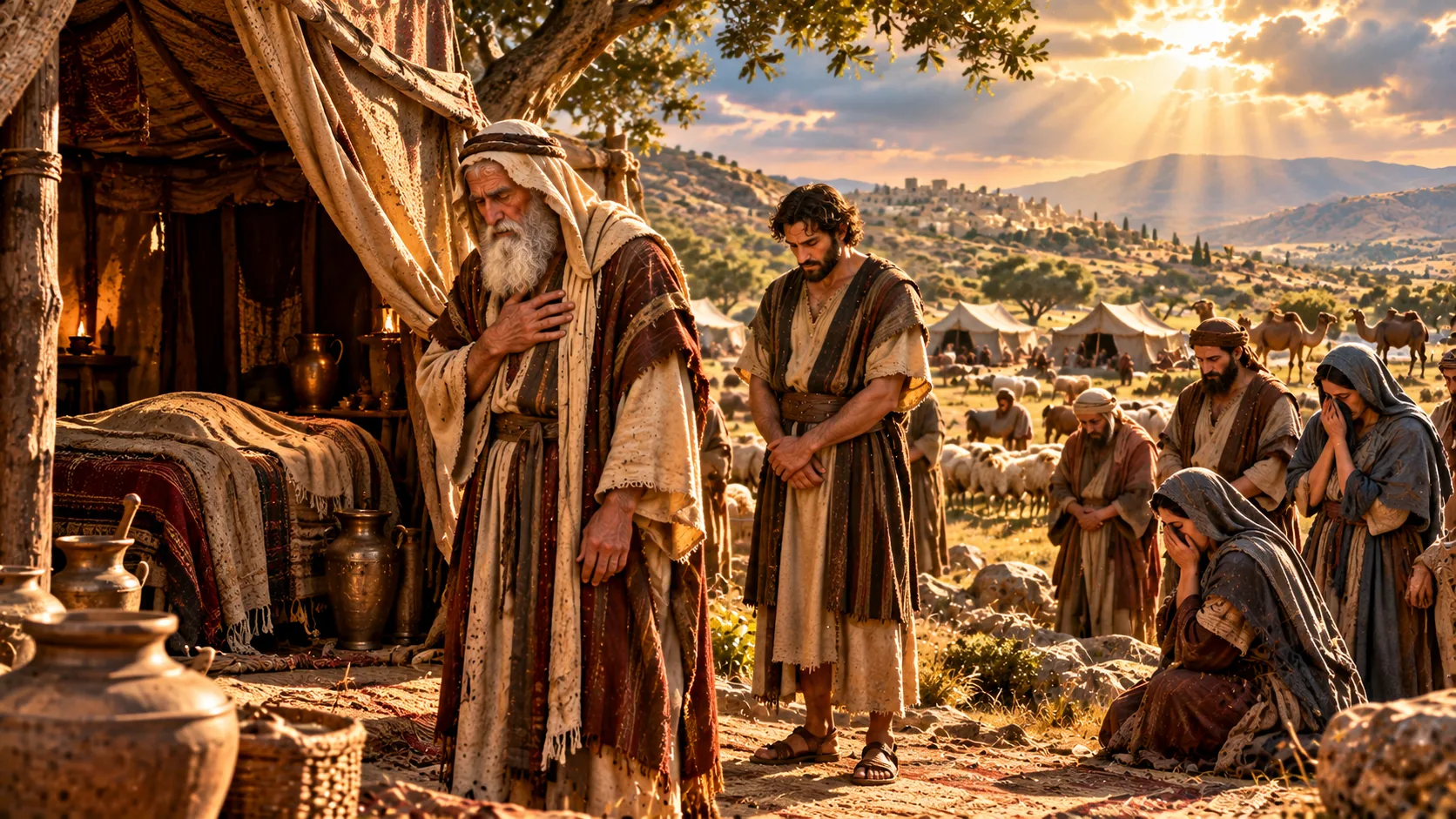
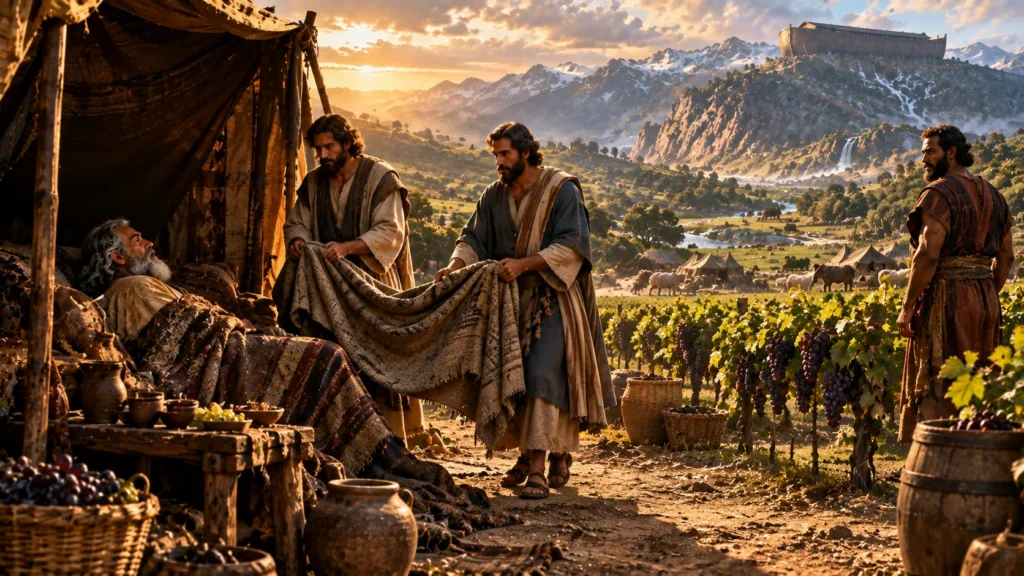
Noah becomes a farmer and plants a vineyard. After drinking wine produced from the vineyard, Noah becomes drunk and lies uncovered inside his tent.
Ham, the father of Canaan, sees his father’s nakedness and tells his two brothers outside. Shem and Japheth respond differently. They place a garment across their shoulders and walk backward into the tent so they can cover their father without looking upon his nakedness.
When Noah awakens and learns what has happened, he pronounces words concerning the future of his sons and their descendants. Significantly, the curse is pronounced upon Canaan, Ham’s son, rather than directly upon Ham.
Noah blesses the Lord, the God of Shem, and speaks of enlargement for Japheth and a future relationship between the descendants of Japheth and Shem.
Genesis Chapter 9 concludes by telling us that Noah lives 350 years after the Flood. His total lifespan is 950 years, and then he dies.
Key Lessons – Genesis Chapter 9
- God gives humanity a new beginning. After the destruction of the Flood, Noah and his family receive the responsibility of repopulating and caring for the renewed earth.
- Human life possesses unique value. Genesis 9 connects the seriousness of taking human life with the fact that humanity was created in the image of God.
- God establishes a covenant extending beyond Noah. The covenant includes Noah, his descendants, and every living creature upon the earth.
- The rainbow is the sign of God’s covenant. It represents God’s promise that He will never again destroy all flesh through a worldwide flood as He did in Noah’s generation.
- God’s faithfulness continues after judgment. The Flood has ended, but God’s relationship with humanity has not. He establishes promises for future generations.
- A righteous person can still fall into sin and weakness. Noah had demonstrated remarkable faith and obedience, yet the account of his drunkenness shows that surviving the Flood did not remove human weakness or sin.
- Shem and Japheth demonstrate respect toward their father. Rather than exploiting Noah’s vulnerable condition, they deliberately avoid looking upon him and cover him.
- Humanity’s story continues through Noah’s family. Shem, Ham, and Japheth become foundational figures in the generations that spread throughout the post-Flood world.
Important Verses
- Genesis 9:1 — “And God blessed Noah and his sons, and said unto them, Be fruitful, and multiply, and replenish the earth.”
- Genesis 9:6 — “Whoso sheddeth man’s blood, by man shall his blood be shed: for in the image of God made he man.”
- Genesis 9:9 — “And I, behold, I establish my covenant with you, and with your seed after you.”
- Genesis 9:11 — “And I will establish my covenant with you; neither shall all flesh be cut off any more by the waters of a flood.”
- Genesis 9:13 — “I do set my bow in the cloud, and it shall be for a token of a covenant between me and the earth.”
- Genesis 9:16 — “And the bow shall be in the cloud; and I will look upon it, that I may remember the everlasting covenant between God and every living creature of all flesh that is upon the earth.”