Zechariah Chapter 6 concludes the prophet’s series of night visions with the dramatic appearance of four chariots emerging from between two mountains of bronze. These chariots represent heavenly agents going throughout the earth under God’s sovereign authority. The chapter then shifts to a symbolic prophetic act involving Joshua the high priest, who is crowned before witnesses. This unusual crowning points beyond Joshua toward “the Branch,” the promised figure who will build the Temple of the Lord and uniquely unite priestly and royal authority. Zechariah 6 therefore moves from God’s sovereignty over the nations to a powerful picture of His coming King-Priest and the future fulfillment of His redemptive purposes.
Zechariah Chapter 6 Summary
Zechariah Chapter 6 begins with the prophet lifting his eyes and receiving another extraordinary vision.
Zechariah sees:
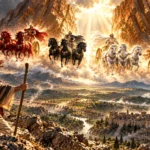
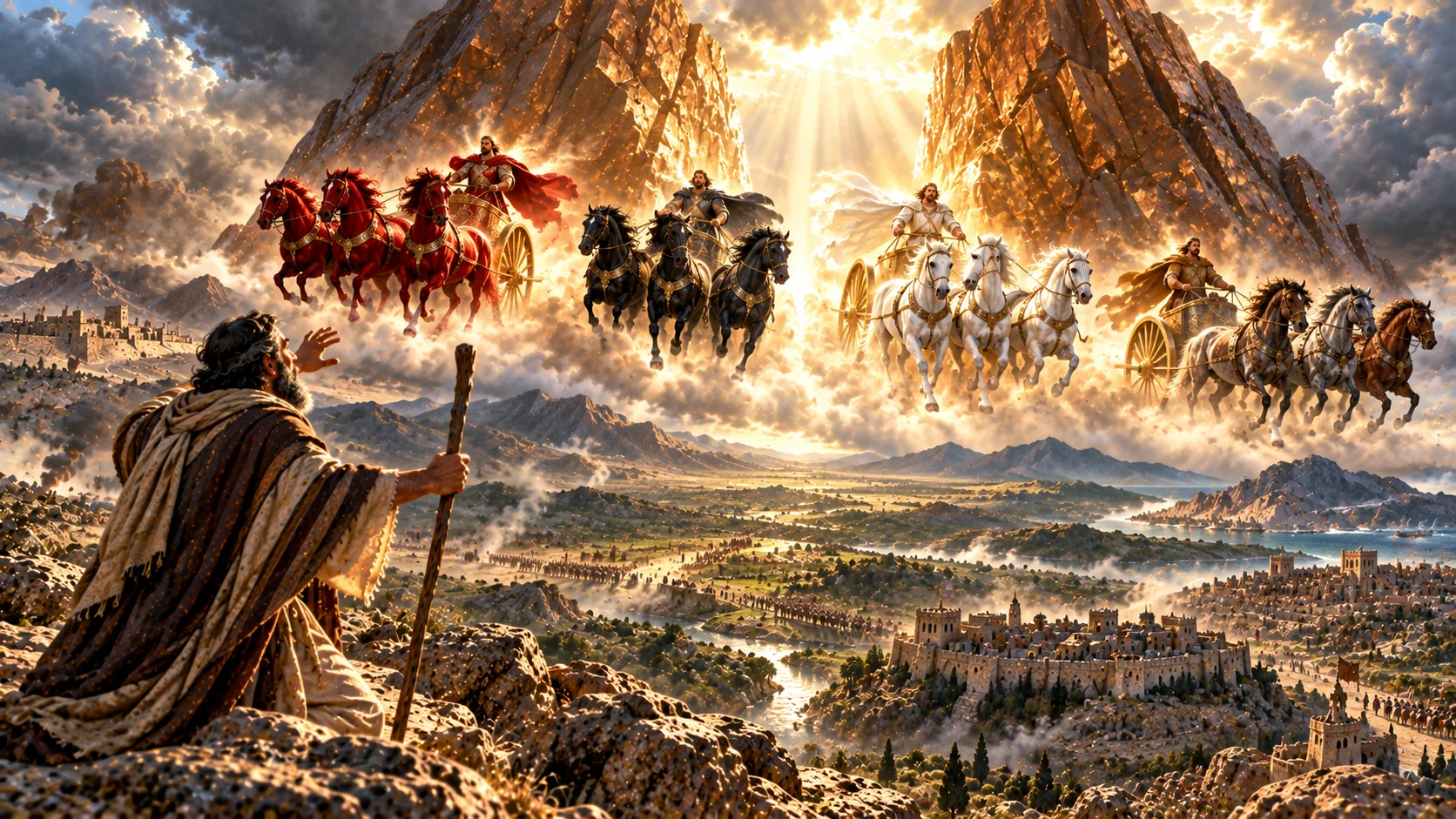
“Four chariots came out from between two mountains; and the mountains were mountains of brass.”
The scene is overwhelming and supernatural.
Four chariots emerge from between these massive bronze mountains.
The first chariot has red horses.
The second has black horses.
The third has white horses.
The fourth has grisled and bay horses, depending on the translation of the Hebrew description.
Zechariah does not understand what he is seeing.
He asks the angel:
“What are these, my lord?”
The angel explains:
“These are the four spirits of the heavens, which go forth from standing before the Lord of all the earth.”
These heavenly agents have been standing before God and now go out under His command.
The vision emphasizes that God is not merely the God of Jerusalem or Judah.
He is:
“The Lord of all the earth.”
The black horses travel toward the north country.
The white horses follow toward the north.
The grisled horses go toward the south country.
The strong horses eagerly seek permission to move throughout the earth.
God commands them:
“Get you hence, walk to and fro through the earth.”
They obey.
The heavenly forces go throughout the earth carrying out the Lord’s purposes.
God then draws Zechariah’s attention specifically toward those who have gone into the north country.
He declares that they have:
“Quieted my spirit in the north country.”
The north was especially significant because Israel’s great imperial enemies had historically invaded from that direction, and Babylon—the nation responsible for Jerusalem’s destruction and Judah’s exile—was associated prophetically with the north.
The vision therefore communicates a powerful truth:
God remains sovereign over the nations that once appeared unstoppable.
Earthly empires rise and fall, but the Lord of all the earth remains in control.
The chapter then moves from Zechariah’s vision to a symbolic prophetic action.
The word of the Lord comes to Zechariah.
He is instructed to receive silver and gold from Heldai, Tobijah, and Jedaiah, men who had come from Babylon.
Zechariah is told to go to the house of Josiah son of Zephaniah.
From the silver and gold, a magnificent crown—or crowns—is to be made.
Then something remarkable happens.
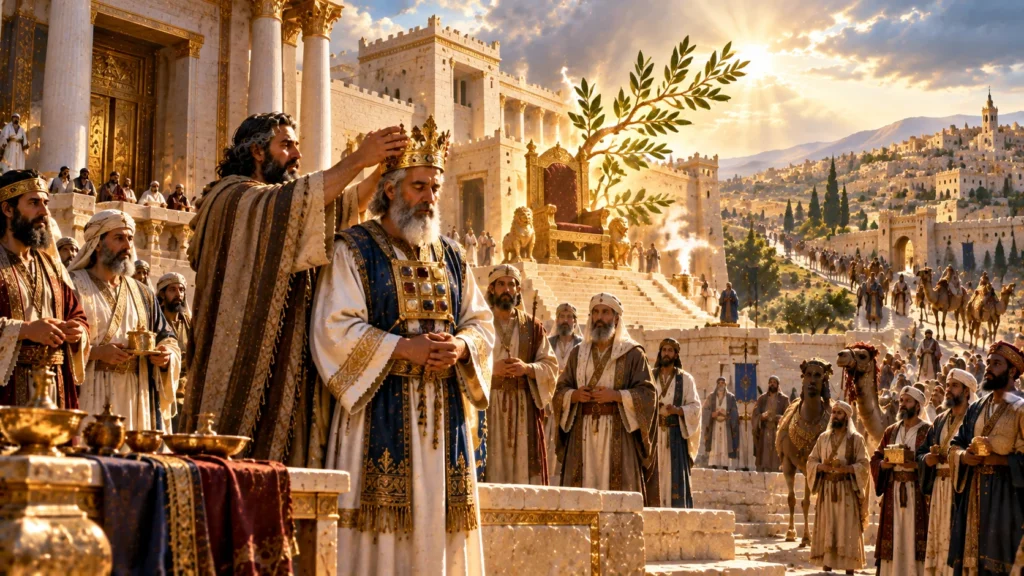
The crown is placed upon the head of Joshua son of Josedech, the high priest.
This would immediately stand out to an Israelite audience.
Joshua is a priest.
He is not the Davidic king.
Under Israel’s established order, the offices of king and priest were distinct.
Yet Joshua is symbolically crowned.
God then commands Zechariah to speak about someone called:
“The BRANCH.”
Zechariah declares:
“Behold the man whose name is The BRANCH; and he shall grow up out of his place.”
The Branch will:
“Build the temple of the LORD.”
The statement is repeated for emphasis.
“Even he shall build the temple of the LORD.”
Historically, Joshua participated in the restoration of worship while Zerubbabel oversaw the rebuilding of the Second Temple.
But Zechariah’s prophecy looks beyond the immediate circumstances toward a greater future fulfillment.
The Branch will possess glory.
He will:
“Sit and rule upon his throne.”
But then comes the extraordinary statement:
“And he shall be a priest upon his throne.”
Royal authority and priestly ministry are brought together.
The Branch will rule like a king while also functioning as a priest.
Zechariah declares:
“The counsel of peace shall be between them both.”
The symbolism points toward harmony between priesthood and kingship.
For Christian readers, this imagery has traditionally been understood as pointing prophetically toward Jesus Christ, who fulfills both roles as the promised Davidic King and the great High Priest.
The crown placed upon Joshua is not simply a personal reward for Joshua.
It becomes a memorial in the Temple of the Lord.
Heldai, Tobijah, Jedaiah, and Hen are associated with this memorial, preserving the significance of what God has revealed.
The chapter then expands the promise even further.
Zechariah declares:
“They that are far off shall come and build in the temple of the LORD.”
God’s future work will reach beyond those immediately present in Jerusalem.
People from far away will participate in what He is accomplishing.
When these things happen, the people will recognize that the Lord of hosts truly sent Zechariah.
Yet the chapter closes with an important condition:
“And this shall come to pass, if ye will diligently obey the voice of the LORD your God.”
God’s people are called not merely to admire prophetic promises but to respond with faithful obedience.
Zechariah Chapter 6 therefore presents a magnificent progression:
heavenly chariots → God’s sovereignty over the earth → judgment and peace → Joshua crowned → the Branch revealed → priest and king united → the Temple built → people from afar gathered → call to obedience.
The chapter begins with God ruling over the nations and ends with the promise of a coming ruler who combines royal authority, priestly ministry, glory, peace, and the building of God’s house.
Key Lessons – Zechariah Chapter 6
- God is sovereign over the entire earth. The heavenly chariots go forth from the presence of “the Lord of all the earth,” showing that no nation exists outside His authority.
- God’s heavenly purposes operate even when people cannot see them. Zechariah is given a glimpse of supernatural activity normally hidden from human sight.
- Earthly empires are temporary, but God’s authority is permanent. The north country that once represented overwhelming imperial power remains completely subject to God.
- God’s promises extend beyond immediate circumstances. Joshua’s symbolic crowning points toward a greater future figure called the Branch.
- 3The Branch uniquely combines kingship and priesthood. He sits upon a throne while also serving as a priest, bringing together two roles normally kept separate in ancient Israel.
- God’s ultimate purpose includes peace. The “counsel of peace” reveals that the coming work of the Branch involves reconciliation, harmony, and righteous rule.
- God’s work reaches people who are far away. Zechariah anticipates people from distant places participating in the building of the Lord’s house.
- God’s promises call for obedience. The chapter ends by reminding the people that hearing prophecy should produce faithful obedience to the Lord.
Important Verses
- Zechariah 6:1
- “Behold, there came four chariots out from between two mountains; and the mountains were mountains of brass.”
- Zechariah 6:5
- “These are the four spirits of the heavens, which go forth from standing before the Lord of all the earth.”
- Zechariah 6:7
- “Get you hence, walk to and fro through the earth.”
- Zechariah 6:8
- “Behold, these that go toward the north country have quieted my spirit in the north country.”
- Zechariah 6:11
- “Then take silver and gold, and make crowns, and set them upon the head of Joshua the son of Josedech, the high priest.”
- Zechariah 6:12
- “Behold the man whose name is The BRANCH; and he shall grow up out of his place, and he shall build the temple of the LORD.”
- Zechariah 6:13
- “He shall bear the glory, and shall sit and rule upon his throne; and he shall be a priest upon his throne.”
- Zechariah 6:15
- “And they that are far off shall come and build in the temple of the LORD.”