
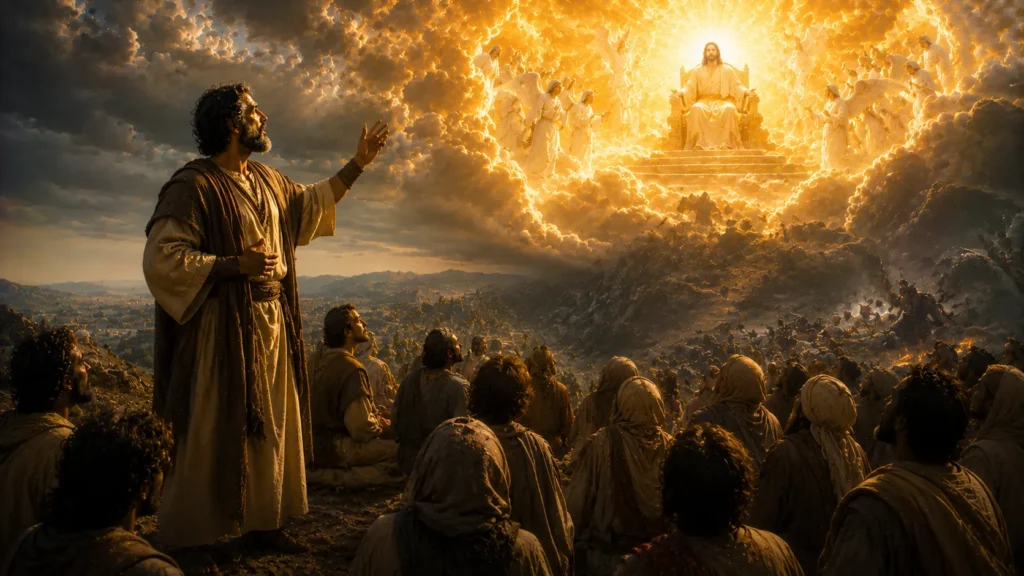

Genesis Chapter 15 is one of the most important chapters in Abram’s story. After the events of Genesis 14, God speaks to Abram in a vision and reassures him with the words, “Fear not, Abram: I am thy shield, and thy exceeding great reward.”
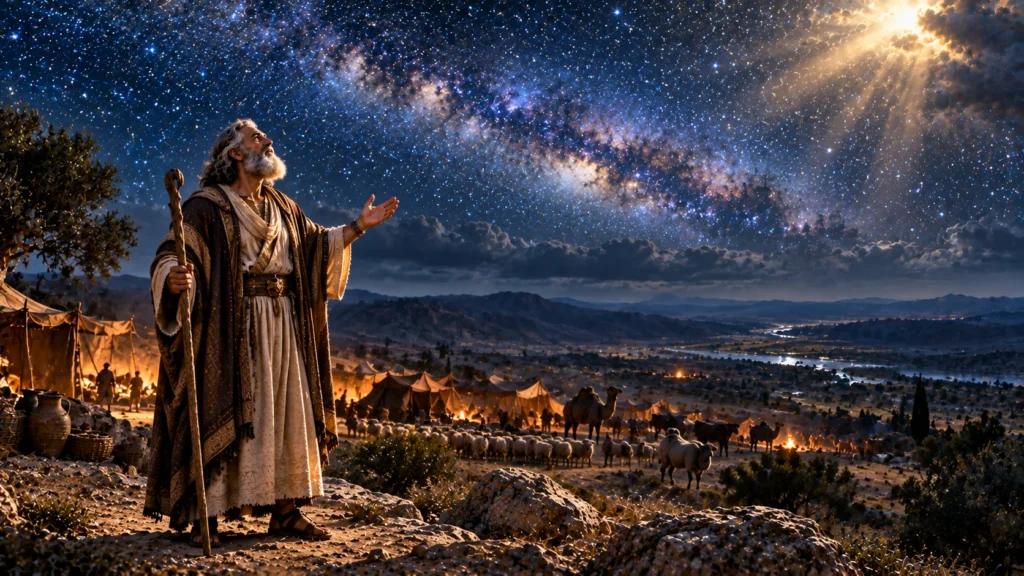
Yet Abram is troubled because he still has no child. God has promised to make him a great nation, but Abram cannot yet see how that promise will be fulfilled. God responds by assuring him that his own son will become his heir and then leads Abram outside to look toward the heavens.
God tells Abram to count the stars, if he is able, and promises that his descendants will be just as numerous. Abram believes the Lord, and his faith is counted to him as righteousness.
The chapter then records a solemn covenant ceremony in which God confirms His promise to give Abram’s descendants the land. Genesis 15 therefore centers on faith, covenant, promise, and God’s faithfulness even when fulfillment still appears impossible.
Genesis Chapter 15 Summary
Genesis Chapter 15 begins after Abram’s victory and his meeting with Melchizedek. The word of the Lord comes to Abram in a vision.
God tells him:
“Fear not, Abram: I am thy shield, and thy exceeding great reward.”
Abram responds by expressing the deepest concern still troubling him. Although God has blessed him greatly, Abram remains childless.
Abram points out that he has no son and that Eliezer of Damascus, a member of his household, appears positioned to become his heir.
God immediately assures Abram that Eliezer will not be his heir. Instead, a son coming from Abram himself will become his heir.
God then brings Abram outside and tells him to look toward the night sky.
He tells Abram to count the stars if he is able to number them.
Then God declares:
“So shall thy seed be.”
Despite his circumstances, Abram believes God’s promise.
Genesis then makes one of its most significant statements:
“And he believed in the LORD; and he counted it to him for righteousness.”
God reminds Abram that He brought him from Ur of the Chaldees in order to give him the land as an inheritance.
Abram asks how he can know that he will possess it.
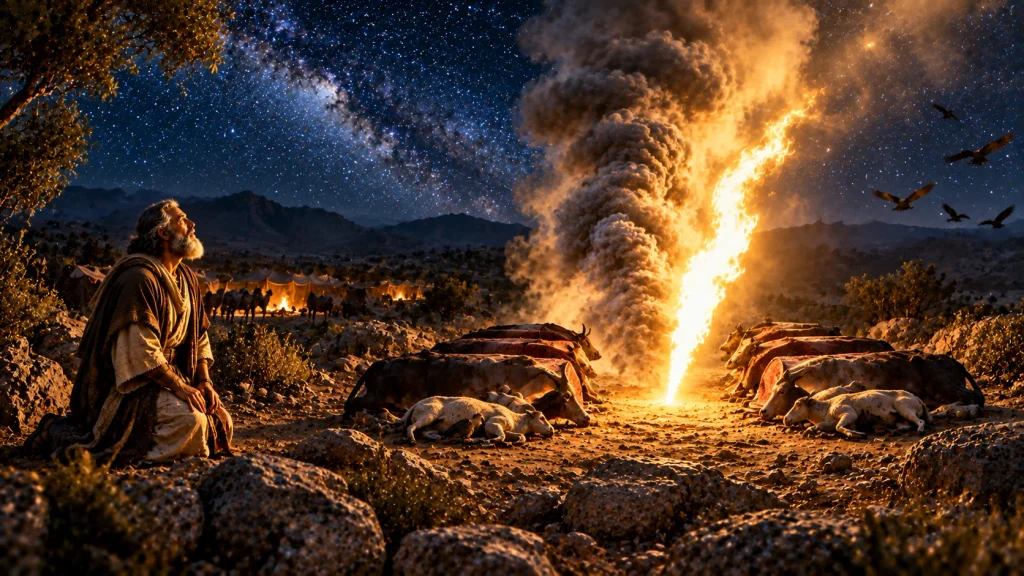
God instructs Abram to prepare several animals for a covenant ceremony: a heifer, a female goat, and a ram, each three years old, along with a turtledove and a young pigeon.
Abram divides the larger animals and arranges the pieces opposite one another. He does not divide the birds.
When birds of prey descend upon the carcasses, Abram drives them away.
As the sun begins to set, Abram falls into a deep sleep, and a terrifying darkness comes over him.
God reveals that Abram’s descendants will one day live as strangers in a land that does not belong to them. They will experience oppression for four hundred years.
However, God promises that He will judge the nation that oppresses them and afterward bring Abram’s descendants out with great possessions.
God also tells Abram that he himself will die in peace at a good old age.
Abram’s descendants will eventually return to the promised land in the fourth generation, because the iniquity of the Amorites has not yet reached its full measure.
After the sun has gone down and darkness has fallen, a smoking furnace and a burning lamp pass between the divided pieces.
These extraordinary signs represent God’s presence in the covenant ceremony without depicting Him in physical human form.
On that day, the Lord formally makes a covenant with Abram and promises the land to his descendants, describing territory extending from the river of Egypt to the great river, the Euphrates.
Genesis Chapter 15 therefore strengthens the promises first given to Abram in Genesis 12. Abram still does not possess the promised land or have the promised son, but God gives him a solemn covenant assuring him that His promises will be fulfilled.
Key Lessons – Genesis Chapter 15
- God reassures Abram when he is afraid and uncertain. The chapter begins with God’s declaration that Abram should not fear because God is his shield and reward.
- Abram brings his questions directly to God. His faith does not prevent him from asking how God’s promises will be fulfilled when he still has no child.
- God promises Abram a biological heir. Eliezer will not inherit the promise; God declares that a son coming from Abram himself will become his heir.
- The stars illustrate the magnitude of God’s promise. Abram cannot count the stars, just as the future multitude of his descendants will exceed what he can presently imagine.
- Abram believes God before seeing the fulfillment. Genesis 15:6 emphasizes that Abram believes the Lord, and his faith is counted to him as righteousness.
- God’s promises may unfold over generations. Abram learns that his descendants will experience hardship before eventually returning to the promised land.
- God reveals both future suffering and future deliverance. Abram’s descendants will be oppressed, but God promises to judge their oppressors and bring His people out.
- The covenant rests upon God’s faithfulness. The dramatic covenant ceremony emphasizes the seriousness and certainty of God’s commitment to fulfill what He has promised.
Important Verses
- Genesis 15:1 — “Fear not, Abram: I am thy shield, and thy exceeding great reward.”
- Genesis 15:4 — “This shall not be thine heir; but he that shall come forth out of thine own bowels shall be thine heir.”
- Genesis 15:5 — “Look now toward heaven, and tell the stars, if thou be able to number them… So shall thy seed be.”
- Genesis 15:6 — “And he believed in the LORD; and he counted it to him for righteousness.”
- Genesis 15:13 — “Know of a surety that thy seed shall be a stranger in a land that is not theirs… and they shall afflict them four hundred years.”
- Genesis 15:18 — “In the same day the LORD made a covenant with Abram, saying, Unto thy seed have I given this land.”