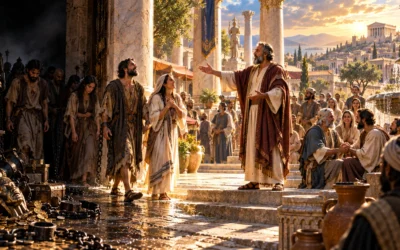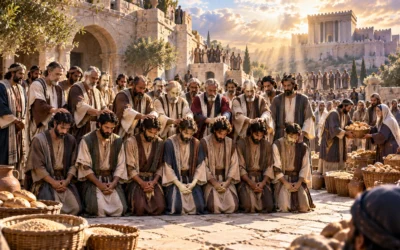

Jeremiah Chapter 6 delivers an urgent warning that judgment is approaching Jerusalem because the people have persistently rejected God’s ways. Jeremiah announces that an invading army from the north is coming against the city, bringing destruction because Judah is filled with oppression, corruption, greed, deception, and spiritual rebellion. Even priests and prophets falsely reassure the people by proclaiming peace when there is no peace. God calls His people to return to the ancient paths—the good way that leads to rest—but they refuse. The chapter ends with the powerful image of God testing His people like metal in a furnace, only to find that they stubbornly remain corrupt. Jeremiah 6 is a sobering warning about the danger of rejecting repeated correction and trusting comforting words instead of God’s truth.
Jeremiah Chapter 6 Summary
Jeremiah 6 begins with an urgent alarm.
Jeremiah warns the people of Benjamin to flee from Jerusalem because disaster is approaching from the north.
Trumpets are to be sounded, warning signals raised, and the people prepared for danger.
A powerful invading army is approaching Judah.
Jerusalem, described poetically as the daughter of Zion, is about to come under attack.
Enemy commanders prepare their forces against the city.
They speak of attacking at noon and even continuing the assault during the night.
God explains why this judgment is coming.
Jerusalem has become filled with oppression.
Jeremiah compares the city’s wickedness to a well continually producing water.
Just as a well naturally keeps bringing forth water, Jerusalem continually produces violence and destruction.
God still warns the city to accept correction before judgment arrives.
Jeremiah then expresses the difficulty of delivering God’s message.
He asks:
“To whom shall I speak, and give warning, that they may hear?”
The people refuse to listen.
God’s word has become offensive to them rather than something they delight in hearing.
Jeremiah feels so overwhelmed by the Lord’s message of judgment that he says he is full of the fury of the Lord and can no longer hold it in.
Judgment will affect the entire society.
Homes, fields, and possessions will pass to others.
God then exposes one of Judah’s deepest problems:
“For from the least of them even unto the greatest of them every one is given to covetousness.”
Greed and dishonesty have spread throughout the nation.
Even prophets and priests practice deception.
Instead of confronting the seriousness of Judah’s spiritual condition, they treat the people’s wounds superficially.
They proclaim:
“Peace, peace; when there is no peace.”
They offer reassurance without repentance.
They promise security while judgment is approaching.
Even more troubling, the people have lost their sense of shame.
Jeremiah says they commit abominations without even knowing how to blush.
Their consciences have become hardened toward wrongdoing.
Yet God still offers them a way back.
The Lord says:
“Stand ye in the ways, and see, and ask for the old paths, where is the good way.”
If they walk in that good way, they will find rest for their souls.
But the people answer:
“We will not walk therein.”
God also appoints watchmen to warn them.
The watchmen tell the people to listen for the sound of the trumpet.
Again, they refuse:
“We will not hearken.”
Their coming judgment is therefore not caused by a lack of warning.
They have repeatedly been warned and repeatedly refused to listen.
God then makes an important statement about worship.
The people continue bringing incense and sacrifices, but God does not accept them.
Religious ceremonies cannot replace obedience.
Outward worship means little when hearts remain determined to reject God’s commands.
Jeremiah again describes the approaching enemy.
A great nation is coming from the north.
Its soldiers carry bows and spears.
They are fierce and relentless.
The sound of their army is compared to the roaring sea.
When Jerusalem hears the reports, fear and anguish spread through the city.
Jeremiah warns the people not to venture into the fields or travel along the roads because the enemy is approaching from every direction.
The people are called to mourn deeply.
Jeremiah compares their coming grief to mourning for an only son.
The destroyer will suddenly come upon them.
Near the end of the chapter, God describes Jeremiah as a tester of metals among His people.
Jeremiah’s prophetic ministry exposes what is truly within them.
The people are compared to metal being refined in a furnace.
The bellows blow fiercely.
The lead is consumed by the fire.
Yet the refining process accomplishes nothing because the wicked refuse to separate themselves from their corruption.
The chapter ends with a devastating verdict:
“Reprobate silver shall men call them, because the LORD hath rejected them.”
Like silver that cannot be purified because its impurities remain, Judah has persistently rejected every attempt at correction.
Jeremiah Chapter 6 therefore presents a tragic progression:
warning → refusal → false peace → another invitation to return → further refusal → judgment.
God repeatedly calls His people to listen, but they continually choose another path.

Key Lessons – Jeremiah Chapter 6
- God gives warnings before judgment. Jerusalem is repeatedly warned about what is coming and given opportunities to change direction.
- Ignoring truth does not eliminate consequences. Judah refuses to listen, but rejecting the warning cannot prevent the approaching judgment.
- False reassurance can be spiritually dangerous. The prophets and priests proclaim “Peace, peace” when genuine peace does not exist.
- Religious activity cannot substitute for obedience. God rejects Judah’s sacrifices because outward worship is accompanied by persistent rebellion.
- Sin becomes especially dangerous when people stop being ashamed of it. Jeremiah describes a society that has become so hardened that it no longer blushes over wrongdoing.
- God calls His people back to the good way. The “old paths” represent returning to the faithful way God has revealed rather than continually pursuing rebellion.
- God’s way brings true rest. The Lord promises that those who walk in the good way will find rest for their souls.
- Repeated rejection can harden the heart. Judah’s tragedy is not that God never warned them, but that they repeatedly answered, “We will not walk therein” and “We will not hearken.”
Important Verses
- Jeremiah 6:10
- “To whom shall I speak, and give warning, that they may hear? behold, their ear is uncircumcised, and they cannot hearken.”
- Jeremiah 6:13
- “For from the least of them even unto the greatest of them every one is given to covetousness.”
- Jeremiah 6:14
- “They have healed also the hurt of the daughter of my people slightly, saying, Peace, peace; when there is no peace.”
- Jeremiah 6:15
- “Were they ashamed when they had committed abomination? nay, they were not at all ashamed, neither could they blush.”
- Jeremiah 6:16
- “Stand ye in the ways, and see, and ask for the old paths, where is the good way, and walk therein, and ye shall find rest for your souls.”
- Jeremiah 6:17
- “Also I set watchmen over you, saying, Hearken to the sound of the trumpet. But they said, We will not hearken.”
- Jeremiah 6:20
- “Your burnt offerings are not acceptable, nor your sacrifices sweet unto me.”
- Jeremiah 6:30
- “Reprobate silver shall men call them, because the LORD hath rejected them.”