

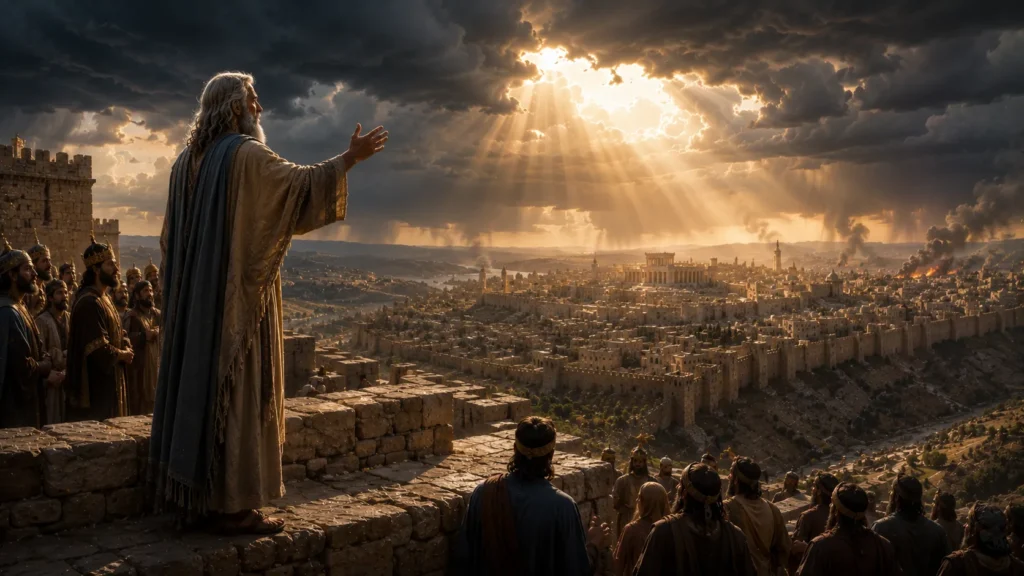

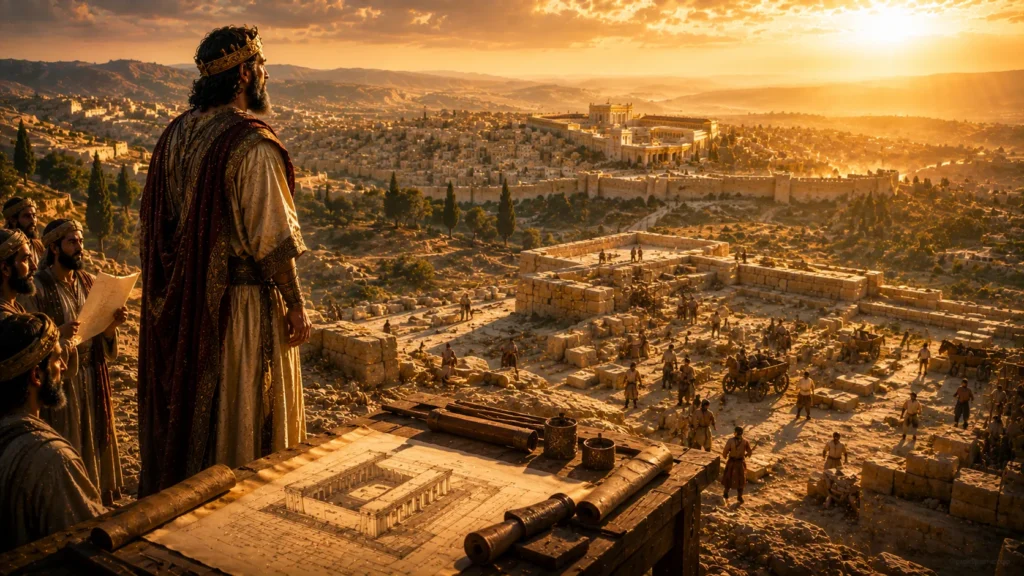

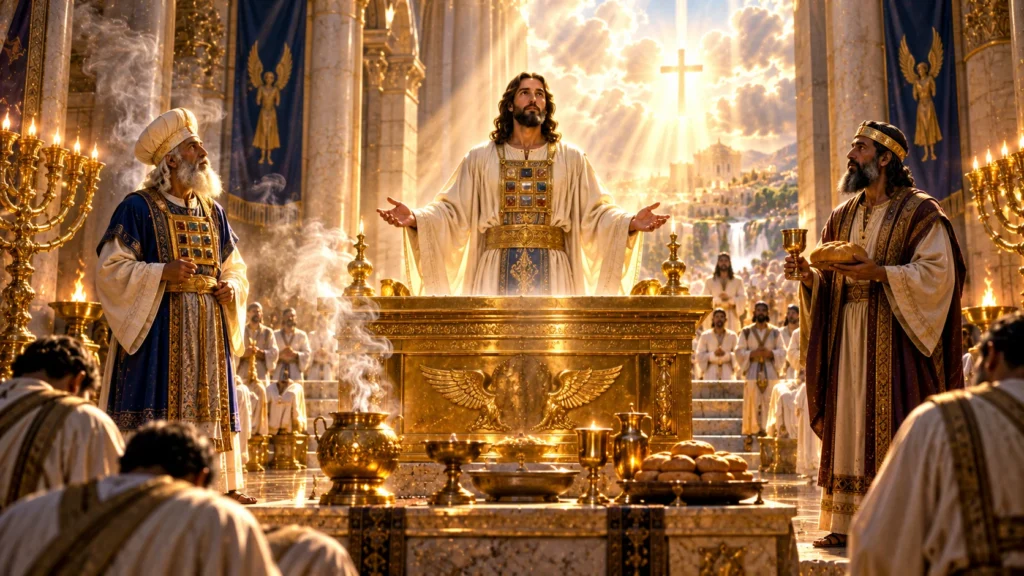
Hebrews Chapter 5 explains the high priesthood of Jesus Christ and shows why He is the perfect mediator between God and humanity. The chapter begins by describing the role of an earthly high priest, who is chosen from among men to represent people before God and offer gifts and sacrifices for sins. Because earthly priests share human weakness, they can deal compassionately with those who struggle, but they must also offer sacrifices for their own sins.
The writer then turns to Jesus, explaining that Christ did not appoint Himself as High Priest but was appointed by God. Jesus is identified as “a priest for ever after the order of Melchisedec.” Through His suffering and perfect obedience, Christ became the source of eternal salvation for those who obey Him. The chapter concludes with a warning against spiritual immaturity, urging believers to grow beyond elementary teaching and become capable of understanding deeper spiritual truth.
Hebrews Chapter 5 Summary
Hebrews 5 begins by explaining the purpose of the high priest.
Every high priest taken from among men is appointed to represent people in matters relating to God.
His responsibilities include presenting gifts and sacrifices for sins.
Because the earthly high priest is himself surrounded by human weakness, he is able to respond compassionately toward those who are ignorant or wandering.
However, his own weakness also creates a limitation.
The earthly high priest must offer sacrifices not only for the sins of the people but also for his own sins.
Furthermore, no one simply chooses the honor of becoming high priest for himself.
He must be called by God, just as Aaron was.
The writer then applies this principle to Jesus Christ.
Christ did not glorify Himself by appointing Himself High Priest.
Instead, God appointed Him.
Hebrews connects Christ’s identity with Old Testament Scripture, first declaring:
“Thou art my Son, to day have I begotten thee.”
Then another passage is applied to Christ:
“Thou art a priest for ever after the order of Melchisedec.”
Jesus therefore possesses a priesthood greater than the temporary Levitical priesthood descended from Aaron.
The chapter then emphasizes the genuine humanity of Christ.
During “the days of his flesh,” Jesus offered prayers and supplications with strong crying and tears to the One who was able to save Him from death.
This demonstrates that Jesus truly experienced human suffering, anguish, and dependence upon the Father.
Yet suffering did not lead Christ into rebellion.
Hebrews declares:
“Though he were a Son, yet learned he obedience by the things which he suffered.”
This does not mean Jesus moved from sinful disobedience into obedience. Rather, through His earthly suffering, He fully experienced and demonstrated obedient submission to the Father’s will.
Having completed His obedient mission, Christ became:
“The author of eternal salvation unto all them that obey him.”
Jesus is therefore not merely another earthly priest offering repeated sacrifices.
He is God’s appointed eternal High Priest and the source of eternal salvation.
The writer again identifies Him as:
“Called of God an high priest after the order of Melchisedec.”
At this point, however, the discussion suddenly changes.
The writer wants to explain much more about Melchisedec and Christ’s priesthood, but the readers have become “dull of hearing.”
They should have matured enough to teach others, yet they still need someone to teach them the basic principles of God’s Word.
Hebrews compares them to people who still require milk instead of solid food.
Milk represents elementary spiritual instruction appropriate for those who are immature.
Solid food represents deeper spiritual truth that requires maturity and discernment.
The writer explains that mature believers have developed their spiritual senses through continued practice so that they can discern both good and evil.
Hebrews Chapter 5 therefore presents two major truths.
First, Jesus Christ is God’s appointed eternal High Priest, perfectly qualified to represent humanity before God because He truly experienced human suffering while remaining obedient.
Second, believers who follow this great High Priest should not remain spiritually immature. They are called to grow in understanding, discernment, obedience, and spiritual maturity.

Key Lessons – Hebrews Chapter 5
- A high priest represents people before God.
- The chapter begins by explaining the priestly responsibility of offering gifts and sacrifices concerning sin.
- Earthly priests were limited by their own weakness.
- Because they were sinners themselves, they had to offer sacrifices for their own sins as well as those of others.
- True spiritual authority comes from God’s calling.
- No one could legitimately appoint himself high priest; the calling came from God.
- Jesus did not appoint Himself High Priest.
- Christ’s priestly authority was given by the Father.
- Jesus possesses an eternal priesthood.
- His priesthood is described as being after the order of Melchisedec rather than merely following the temporary Levitical system.
- Jesus truly experienced human suffering.
- His prayers, tears, and anguish demonstrate the reality of His humanity.
- Christ remained obedient through suffering.
- Jesus perfectly fulfilled the Father’s will even when obedience involved profound suffering.
- Jesus is the source of eternal salvation.
- Unlike temporary earthly sacrifices, Christ provides salvation with eternal significance.
- Spiritual growth is expected of believers.
- Christians should not remain indefinitely dependent upon only elementary teaching.
- Understanding Scripture requires spiritual maturity.
- Deeper biblical truths become increasingly understandable as believers grow in faith and knowledge.
Important Verses
- Hebrews 5:1 — Every earthly high priest is chosen from among men and appointed to represent people before God through gifts and sacrifices for sins.
- Hebrews 5:2 — Because the earthly high priest shares human weakness, he can respond compassionately toward those who are ignorant and wandering.
- Hebrews 5:4 — “And no man taketh this honour unto himself, but he that is called of God, as was Aaron.”
- Hebrews 5:5 — Christ did not glorify Himself by making Himself High Priest; His authority came from God.
- Hebrews 5:6 — “Thou art a priest for ever after the order of Melchisedec.”
- Hebrews 5:7 — During His earthly life, Jesus offered prayers and supplications with strong crying and tears.
- Hebrews 5:8 — “Though he were a Son, yet learned he obedience by the things which he suffered.”
- Hebrews 5:9 — Christ became “the author of eternal salvation unto all them that obey him.”
- Hebrews 5:10 — Jesus is called by God “an high priest after the order of Melchisedec.”
- Hebrews 5:12 — The readers should have matured enough to teach others but still require instruction in elementary spiritual truths.
- Hebrews 5:13 — Those dependent upon spiritual milk remain inexperienced in the word of righteousness.
- Hebrews 5:14 — Solid spiritual food belongs to the mature, whose senses have been trained to discern both good and evil.